Creative Minds 𖹭 Happy Hearts

Detergent on Water Surface Tension Lab Sheet
A paper clip floating on water sounds impossible until your student changes one variable. This detergent on water surface tension lab makes that exact moment the centerpiece of the lesson.
Your student starts with a question printed right on the sheet: how does adding detergent to water affect its surface tension? The experiment uses three cups of water at different detergent concentrations, 0%, 0.1%, and 0.5%, and asks students to carefully float paper clips or a sewing needle on the surface, counting how many stay afloat before the surface gives way. A three-trial data table keeps results organized, and four analysis questions push students to explain what they observed and connect it to real-life applications. This sheet fits grades 4-7 comfortably and works well as a standalone lesson or inside a unit study on physical properties of water or chemistry of solutions.
Completing the detergent on water surface tension lab gives your homeschooler hands-on practice forming a written hypothesis, running controlled trials, recording quantitative data, and drawing evidence-based conclusions. The background section on the sheet defines surface tension clearly enough that your student can read it independently before starting, making this a strong candidate for a self-directed science block. It builds naturally into broader chemistry topics like molecular attraction, solubility, or the science of cleaning.
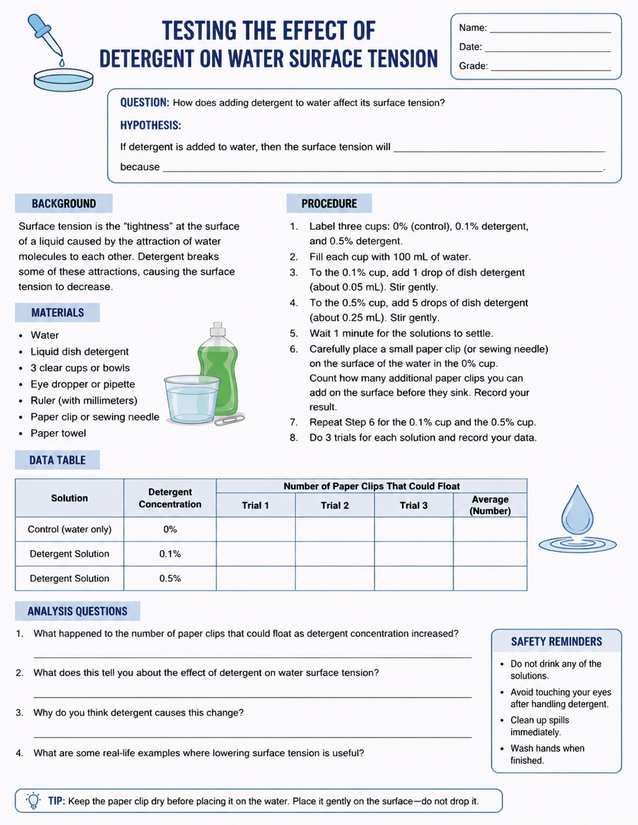
Paper clips float or sink depending on detergent concentration. This detergent on water surface tension lab suits grades 4-7 homeschoolers perfectly.
Investigating the Detergent on Water Surface Tension Lab

Usage Notes
Every item on the materials list is a household supply: water, liquid dish detergent, clear cups, an eye dropper or pipette, a ruler, paper clips or a sewing needle, and a paper towel. No specialty equipment is required. The safety reminders on the sheet flag three practical points: do not drink the solutions, avoid touching eyes after handling detergent, and clean up spills immediately.

Printing Tips
A single copy on standard copy-weight paper works fine since students write directly in the data table and answer lines. Tuck it into a three-ring lab notebook or clip it to a hard surface near the sink where the experiment runs, keeping it flat and dry between steps.