Creative Minds 𖹭 Happy Hearts

Digestive Enzyme Action Lab Sheet, Amylase and Starch
Your student’s own saliva is the star of this digestive enzyme action lab sheet, showing amylase at work breaking starch into simpler sugars in just fifteen minutes.
This lab sheet guides grades 5 to 7 homeschoolers through a controlled experiment comparing starch plus saliva against starch plus water. Your student labels two cups, adds warm starch solution, introduces either saliva or plain water, and then waits fifteen minutes before adding iodine drops to reveal whether starch is still present. A color guide printed right on the sheet decodes the results: blue-black means starch remains, yellow-brown means it has mostly broken down. The observations table captures readings at both the fifteen-minute and thirty-minute marks, and four Think and Answer questions push your student to explain why the test and control cups looked different.
This digestive enzyme action lab sheet works naturally inside a unit study on human body systems, digestion, or biochemistry, and it stands alone just as well as a single-day hands-on learning activity. An extension section suggests testing at different temperatures and with other enzymes like protease, giving your homeschooler a clear path toward a multi-day investigation if you want to go deeper. Completing the sheet demonstrates that your student can design a controlled experiment, use an indicator chemical correctly, and connect lab results to what happens inside the human digestive system.
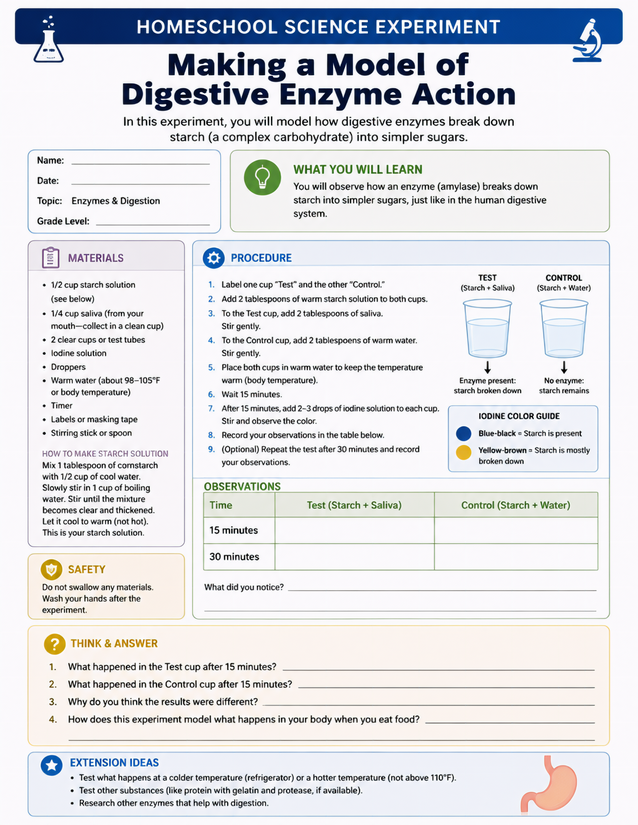
Record how amylase breaks down starch in this digestive enzyme action lab sheet for grades 5-7 homeschoolers. Instant download.
Investigating the Digestive Enzyme Action Lab Sheet with Iodine

Usage Notes
Most materials here are household items: cups or test tubes, warm water, a timer, labels or masking tape, and a stirring stick. Iodine solution is the one specialty supply and is available at most pharmacies. The safety note on the sheet reminds students not to swallow any materials and to wash hands after the experiment, so keep that step visible before your student begins.

Printing Tips
Twenty-four pound paper holds up fine for writing during the wait periods, but 32 lb is worth it if your student tends to press hard with a pen. Slide a loose sheet onto a clipboard so it stays flat on the counter next to the cups, or punch and insert it into a dedicated lab notebook after the experiment is complete.