Creative Minds 𖹭 Happy Hearts

Dissecting a Flower Lab Sheet, Stigma to Ovule
A real lily comes apart one petal at a time on this dissecting a flower lab sheet, giving your student names and functions for eight distinct parts before they reach the conclusion section.
Structured around a single fresh flower, this dissecting a flower lab sheet walks your homeschooler through the full anatomy of a bloom from the sticky stigma at the top to the ovule at the base. Students observe, describe, and sketch each of the eight labeled parts, recording color, size, shape, and texture in a dedicated data table. The sheet is suited for grades 4 through 7 and works equally well with a lily, tulip, or hibiscus.
Five analysis questions push beyond simple identification, asking your student to distinguish male from female parts, explain how petals and sepals function, and trace what happens to the ovary after pollination. A sketch-your-flower section on the back extends the lab into observational drawing, making it a natural fit for a plant biology unit study or a Charlotte Mason nature study sequence. Completing the sheet demonstrates that your homeschooler can connect physical structures to biological function, not just label a diagram.
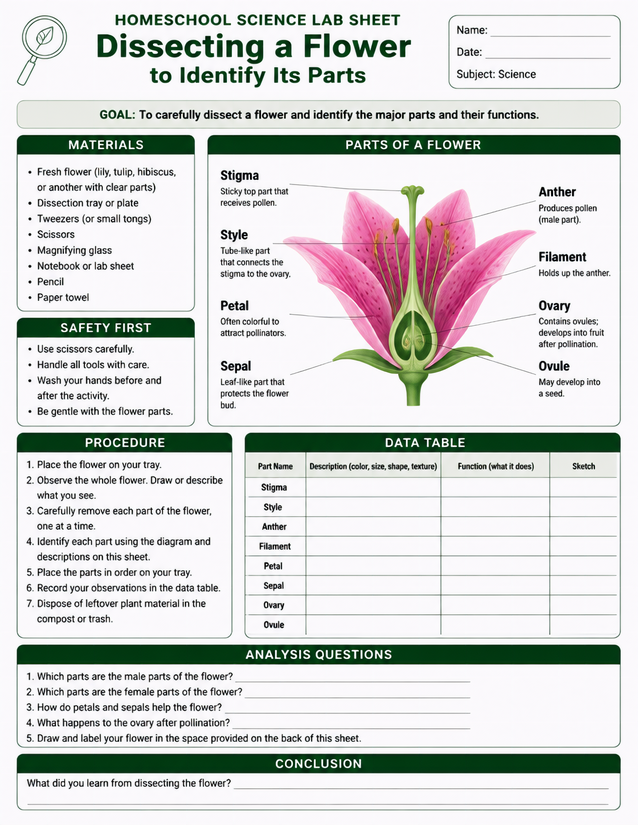
Record observations on a dissecting a flower lab sheet covering eight labeled parts, grades 4 through 7. Includes a data table and analysis questions.
Investigating with a Dissecting a Flower Lab Sheet, Part by Part

Usage Notes
Fresh flowers with clear, accessible parts are listed first: lily, tulip, or hibiscus all work well and are available at most grocery stores. Beyond the flower, your student needs tweezers or small tongs, scissors, a dissection tray or plate, and a magnifying glass. Scissors are specifically called out in the safety section, so brief your homeschooler on careful handling before the lab begins.

Printing Tips
Cardstock at 65-pound weight holds up better than copy paper when the sheet rests on a damp tray next to a flower. Print one copy per student so the data table and sketch section stay intact for their lab notebook or science portfolio.