Creative Minds 𖹭 Happy Hearts

Division as Equal Groups Worksheet, Cookies to Balloons
Four word problems, one worked cookie example, and blank division sentences give your student a concrete way to see what division actually means. This division as equal groups worksheet builds the mental model before numbers get abstract.
Each of the four problems on this division as equal groups worksheet asks your student to read a sharing scenario, draw or use the picture to partition objects, write the division sentence, and fill in how many items land in each group. Problems use apples, stars, crayons, and balloons with dividends of 15, 18, 20, and 24. A fully worked cookie example at the top walks through the logic step by step, making this a solid fit for grades 2 to 3 in your homeschool math sequence.
Add this sheet after your student can explain what division means in words but before moving to fact memorization. It works well independently once you have walked through the example together, or as a guided activity during a lesson on fair sharing and equal partitioning. Completing it builds the habit of connecting a concrete grouping model to a written number sentence, which is the conceptual foundation your student needs before tackling division facts.
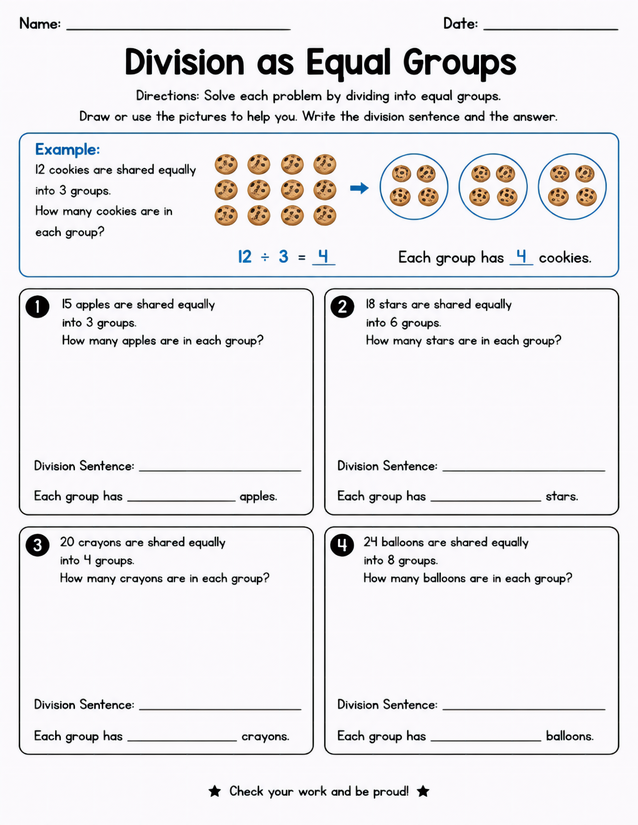
Four word problems make this division as equal groups worksheet ideal for grades 2 to 3 homeschoolers learning to partition objects.
Working Through a Division as Equal Groups Worksheet

Usage Notes
Pencil is the right tool here since students fill in division sentences and write answers in blank lines. The drawing space in each problem box supports independent practice once your student understands the example. Guided use on the first problem or two helps less confident learners get started.
Printing Tips
Standard copy paper works well at portrait orientation, which matches the layout exactly. Print a small set if you plan to repeat the activity with different numbers written in.