Creative Minds 𖹭 Happy Hearts

Effect of Acid on Different Types of Stone Lab Sheet
Five stones, one dropper of white vinegar, and suddenly your student is watching limestone fizz while quartz sits silent. The effect of acid on different types of stone reveals exactly why some buildings erode faster than others.
Students test white vinegar (5% acetic acid) against five suggested stones: limestone, marble, chalk, granite, and quartz. The results table asks them to note whether bubbling occurred, rate reaction strength on a four-point scale from none to strong, describe surface changes, and add optional drawings. A hypothesis section before the experiment and a conclusion section after it push students to reason before and after, not just observe. Suited for grades 4-7, this lab sheet works well within an earth science or geology unit.
The effect of acid on different types of stone connects directly to real-world topics like acid rain, cave formation, and building material selection, making it a strong anchor for a broader unit study on rocks and minerals or weathering. Your homeschooler completes the sheet from question through conclusion in a single sitting, and the Think and Extend section prompts them to move from observation toward explanation, a skill that carries across every science discipline.
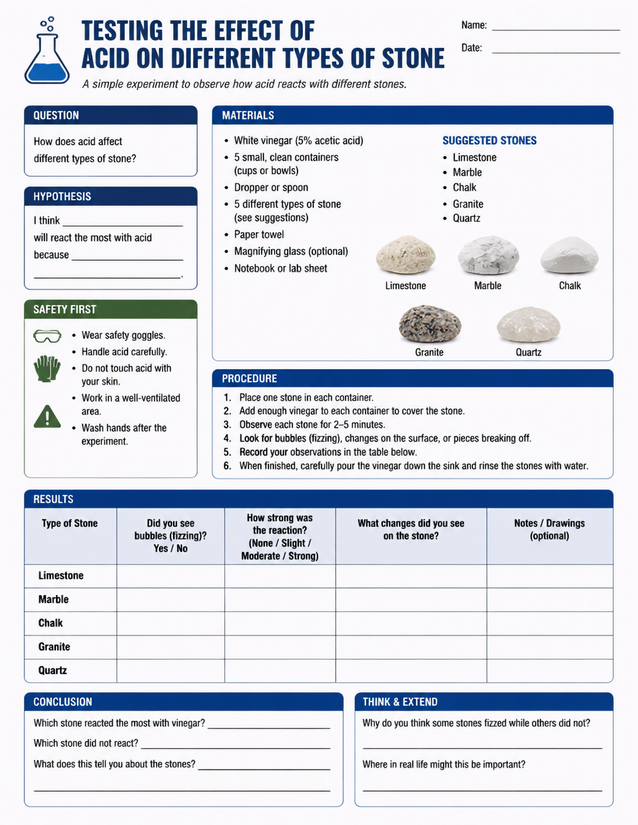
Record how acid reacts with limestone, marble, chalk, granite, and quartz using this effect of acid on different types of stone lab sheet for grades 4-7.
Investigating the Effect of Acid on Different Types of Stone

Usage Notes
White vinegar is the only specialty-adjacent item here, and most families already have it in the kitchen. Your student will also need five small containers, a dropper or spoon, paper towels, and five stone samples. Safety goggles are listed as required, so confirm you have a pair on hand before the experiment begins.

Printing Tips
Copy-weight paper (20-24 lb) holds up fine since students record observations after the experiment rather than writing tableside with wet hands. Slide the sheet into a lab notebook for the geology or earth science unit, or keep it loose on a clipboard if your student prefers to sketch directly during observation.