Creative Minds 𖹭 Happy Hearts

Testing the Effect of Different Fertilizers on Plant Growth
Four small pots, three fertilizer types, and one control group: the effect of different fertilizers on plant growth has never been this straightforward to set up and record.
This lab sheet walks your student through a structured comparison of three fertilizer types, including compost or organic fertilizer, fish emulsion, and a chemical all-purpose fertilizer, against a no-fertilizer control. Your homeschooler plants the same number of fast-growing seeds (bean or radish work well) in four labeled pots, then measures and records plant height in centimeters daily for up to seven days. The data table tracks each pot’s daily height alongside an observations column, making it a strong fit for grades 4-7 working on plant biology or the scientific method.
The effect of different fertilizers on plant growth is a natural centerpiece for a botany or soil science unit study. Your student works through a complete experiment cycle: forming a hypothesis, controlling variables like soil type, water amount, light, and pot size, and then drawing conclusions by identifying which fertilizer performed best and which underperformed. Completing this sheet demonstrates the ability to design a fair test, collect quantitative data over time, and communicate results in writing.
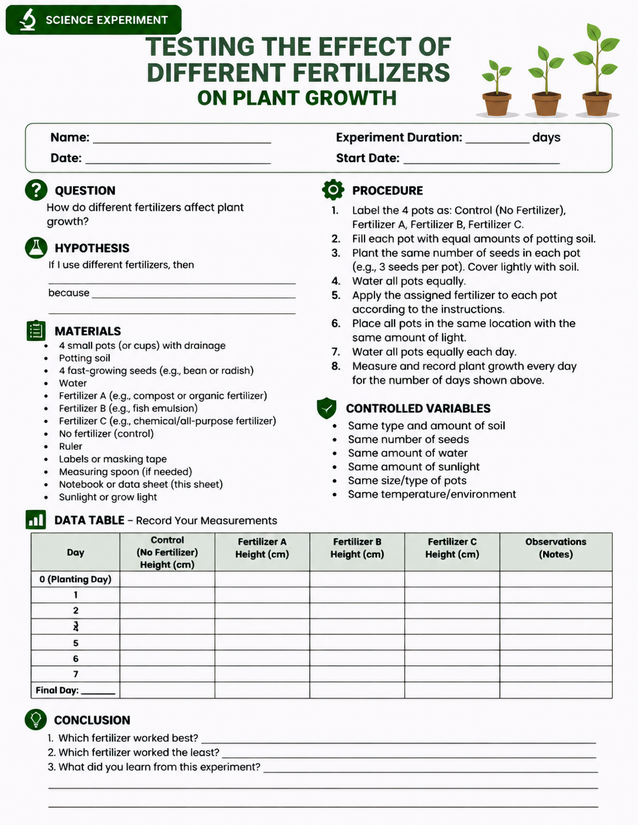
Four pots, three fertilizer types, one control: the effect of different fertilizers on plant growth, grades 4-7, downloads instantly.
Getting Your Homeschooler Started with the Effect of Different Fertilizers on Plant Growth

Usage Notes
Most materials here are household or garden-shed items: small cups or pots with drainage, potting soil, water, fast-growing seeds, and labels. The three fertilizer types (organic, fish emulsion, and chemical all-purpose) may require a quick trip to a garden center, and fish emulsion carries a strong odor, so outdoor or well-ventilated setup is worth planning ahead. A measuring spoon and ruler are the only tools listed beyond the sheet itself.

Printing Tips
Heavier copy paper (24 lb) holds up better than standard weight when students are writing daily measurements over a week-long experiment. Loose on a clipboard near the grow area works well, or punch and insert it into your homeschool science binder once the final day measurements are recorded.