Creative Minds 𖹭 Happy Hearts

Effect of Exercise on Lung Capacity, Homeschool Science Lab
Breathe normally, then breathe after five minutes of jumping jacks, and the numbers on the spirometer tell a different story. This effect of exercise on lung capacity lab gives your student the data table to prove it.
Structured for grades 5-7, this lab walks students through measuring lung capacity at three distinct points: after five minutes of rest, immediately following exercise, and again after a recovery rest. The driving question is printed right at the top of the sheet: does exercise affect how much air your lungs can hold? Students write a hypothesis in their own words, follow an eight-step procedure using a spirometer, and record three trials for each condition before calculating an average.
The effect of exercise on lung capacity fits naturally into a human body unit study or a broader life science sequence on the respiratory system. It works as a standalone lesson but pairs well with heart rate experiments for a multi-day investigation into how the body responds to physical stress. By the time your student fills in the conclusion and thinks through the bonus questions about long-term training, they have moved beyond recording numbers into actually interpreting what physiological change looks like on paper.
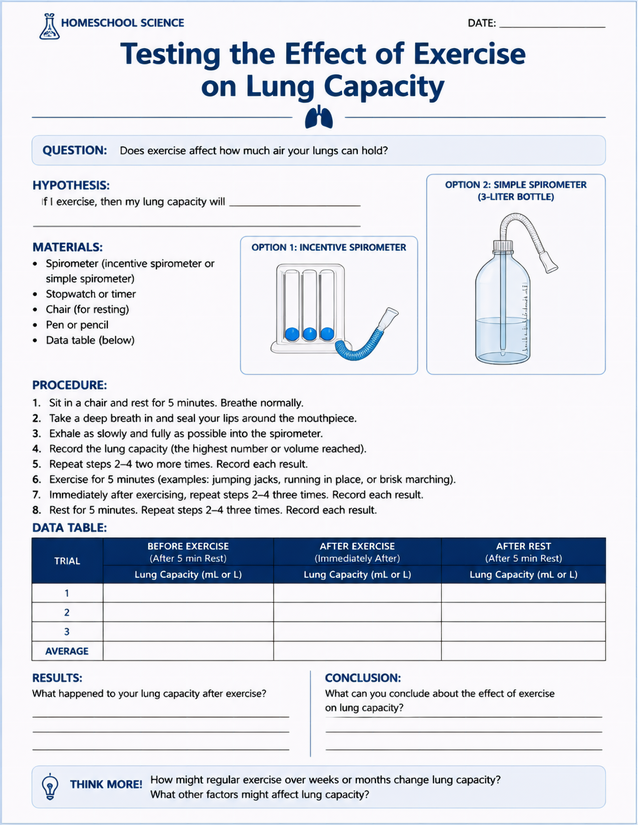
Does exercise change how much air your lungs hold? This effect of exercise on lung capacity lab suits grades 5-7 homeschoolers perfectly.
Getting Started with the Effect of Exercise on Lung Capacity

Usage Notes
Two spirometer options are shown on the sheet: an incentive spirometer (the kind used in hospitals) or a DIY simple spirometer made from a 3-liter bottle. Beyond the spirometer, everything else is a household item: a stopwatch or timer, a chair, and a pen or pencil. If your student uses the bottle method, standard lab safety applies around water and tubing.

Printing Tips
Twenty-four pound paper gives the data table enough body to write on during the experiment without warping if the sheet gets set on a damp surface. Punch and insert it into a science lab notebook after the experiment is complete, or keep it loose on a clipboard during the active exercise portion of the procedure.