Creative Minds 𖹭 Happy Hearts

Elasticity of Different Rubber Band Brands Lab Sheet
Rubber bands look identical until you hang a 100g mass from them. This lab sheet puts the elasticity of different rubber band brands to a measurable, millimeter-by-millimeter test.
Students in grades 5-7 use this lab sheet to compare how far three rubber band brands stretch under a standardized 100g load. The data table records original length, new length with load, and calculated stretch in millimeters across three trials for each brand, with a row for averaging results. Analysis questions push beyond the numbers, asking which brand stretched most on average, which stretched least, what might cause the differences, and which brand would perform best in a slingshot or catapult.
The elasticity of different rubber band brands experiment works well as a standalone physics unit or inside a broader materials science or forces unit study. Completing the sheet asks your homeschooler to gather repeated-trial data, calculate differences, and write a two to three sentence conclusion, which together demonstrate both measurement precision and basic scientific reasoning.
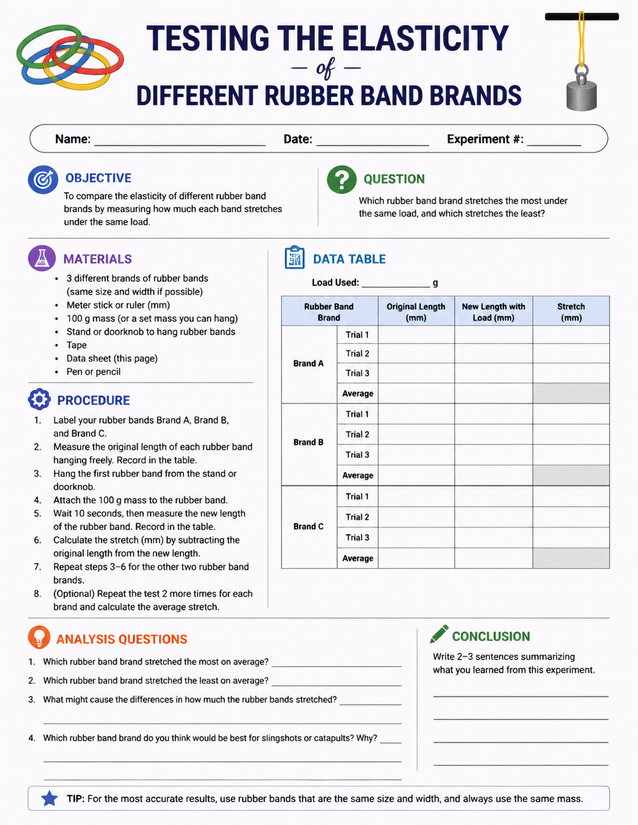
Grades 5-7 homeschoolers measure stretch in millimeters across three rubber band brands using the elasticity of different rubber band brands lab sheet.
Recording Results for the Elasticity of Different Rubber Band Brands

Usage Notes
Nearly everything on the materials list is already in the house. Your student needs three rubber band brands in the same size and width, a meter stick or ruler, a 100g mass or equivalent weight, tape, and a stand or doorknob as an anchor point. No specialty lab supplies are required, though matching band dimensions across brands matters for fair results, so check sizes before the experiment begins.

Printing Tips
Loose on a clipboard works well here, since students will be reaching up to hang and remeasure bands repeatedly and a flat notebook gets awkward. Print on 24-lb paper so the data table holds up if a pen presses firmly through multiple trial rows.