Creative Minds 𖹭 Happy Hearts

Electrical Conductivity of Different Solutions Lab Sheet
Six cups, one bulb, and a battery reveal which liquids carry a charge. Your student tests the electrical conductivity of different solutions and records exactly what the light does.
Students label six cups with distilled water, salt solution, baking soda solution, sugar solution, vinegar, and lemon juice, then build a simple conductivity tester using a battery, LED or bulb, wires, a switch, and electrode probes. The results table asks them to note whether the light turns on and to rate conductivity as strong, weak, or none, making this a strong fit for grades 5 through 7 in a homeschool chemistry or physical science unit. Each observation column also has space for written notes, so students are not just checking boxes but explaining what they see.
The electrical conductivity of different solutions lab works well as a standalone lesson on ionic versus covalent substances, and it fits naturally into a broader unit on solutions, electrolytes, or electrical circuits. Four analysis questions push beyond the data: students identify the best conductor, name non-conductors, hypothesize why some solutions carried current, and consider how dissolved substance concentration might affect results. A printed safety reminder at the bottom of the sheet flags that no solution should be tasted and that hands should be washed after the experiment.
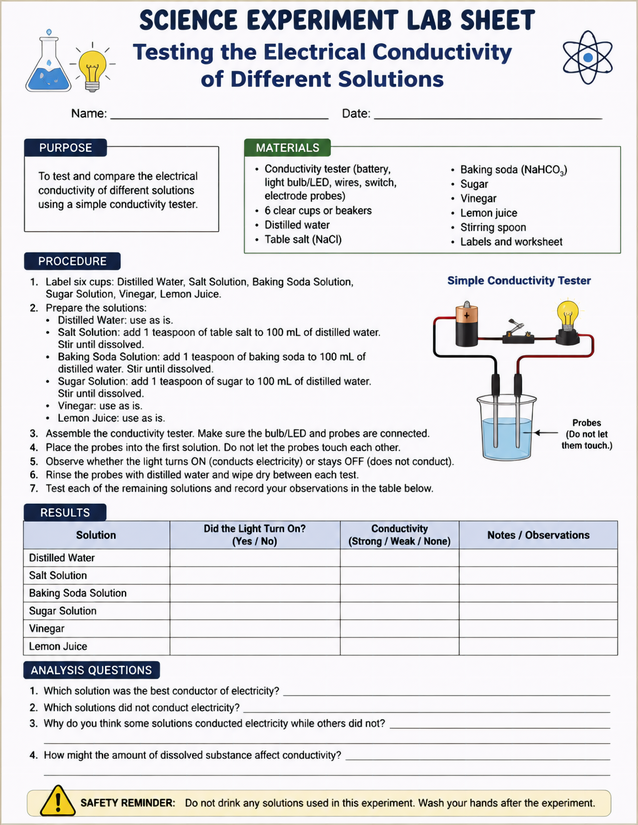
Six household liquids, one conductivity tester: this electrical conductivity of different solutions lab suits grades 5 through 7 homeschoolers perfectly.
Investigating the Electrical Conductivity of Different Solutions

Usage Notes
All six test solutions use pantry staples: table salt, baking soda, sugar, vinegar, and lemon juice mixed with distilled water, so no specialty supplies are needed. The conductivity tester requires a battery, LED or small bulb, wires, a switch, and two electrode probes, which are available inexpensively as a kit or can be assembled from hardware store components. The sheet’s safety note flags that none of the solutions should be consumed and that probes must not touch each other during testing.

Printing Tips
Twenty-four-pound paper gives the results table enough weight to handle wet hands or a damp lab surface without tearing. Slide the sheet into a clipboard for easy writing between solution tests, or punch and insert it into a dedicated science lab notebook once complete.