Creative Minds 𖹭 Happy Hearts

Electrolysis of Water Lab Sheet, Hydrogen and Oxygen Collection
Bubbles collecting in inverted test tubes tell the whole story: your electrolysis of water lab sheet walks students through splitting H₂O into its two gases using a 9V battery.
This lab guides your homeschooler through building an electrolysis apparatus from scratch and using a low-voltage DC current to separate water into hydrogen and oxygen gas. Students fill two inverted test tubes with baking soda solution, insert graphite electrodes, connect alligator leads to a 9V battery, and record gas volume at the cathode and anode in milliliters over time. An apparatus diagram labels the negative and positive electrodes, the collection tubes, and the power source, giving grades 6 to 8 a clear visual anchor before they begin.
The electrolysis of water lab sheet extends naturally into a chemistry unit on chemical reactions, conservation of matter, or properties of gases. Your student demonstrates understanding by writing the word equation, balancing the chemical equation, and answering questions about which gas collects in greater volume and why. Seven guided analysis questions push beyond observation into reasoning, making this sheet strong enough to anchor a standalone lesson or serve as the capstone experiment in a larger electrochemistry unit study.
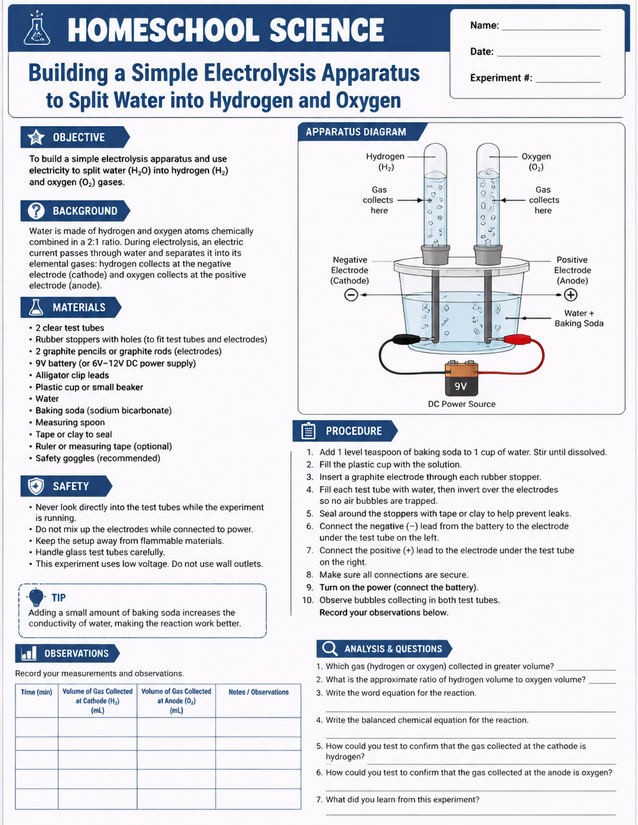
Grab this electrolysis of water lab sheet for grades 6 to 8 and watch hydrogen and oxygen separate in real time. Instant download.
Investigating the Electrolysis of Water Lab Sheet Step by Step

Usage Notes
Most materials here are genuine household or easily sourced items: a 9V battery, two graphite pencils used as electrodes, a plastic cup, baking soda, and water. The two items that may require a quick purchase are rubber stoppers with holes and alligator clip leads. Safety goggles are listed as recommended on the sheet, and the included safety section specifically cautions against using wall outlets and warns students never to mix up the electrodes while current is flowing.

Printing Tips
A 24-pound multipurpose paper handles this sheet well since students are writing in an observations table during a live experiment, and slightly heavier stock resists moisture better if the workspace is wet. Slip it into a plastic page protector inside a lab notebook, or keep it as a loose sheet on a clipboard positioned away from the water setup.