Creative Minds 𖹭 Happy Hearts

Equivalent Fractions Worksheet, Two Sections Plus a Challenge
Fractions that look different but mean the same thing, this equivalent fractions worksheet walks your student through that concept in two distinct practice formats.
Laid out across two numbered sections, this equivalent fractions worksheet asks students to do two different things. Section one gives five fractions, including 1/2, 1/3, 2/3, 1/4, and 3/4, and asks students to write two equivalent fractions for each one. Section two shifts to fill-in-the-blank equations where the denominator is given and students supply the missing numerator, working through six pairs. A visual reference box at the top shows circle models for 1/2, 2/4, and 4/8 with the shaded regions matching, giving students a concrete anchor before they move into the abstract problems. This page suits grades 3 to 4 in a homeschool math sequence.
The equivalent fractions worksheet fits naturally into a fractions unit study, either as a first independent practice after you introduce the concept together or as a review session a few days later. The two-section structure means you can assign section one on day one and section two the next, or use the full page in a single sitting for a confident learner. A small challenge problem at the bottom asks students to find a fraction equivalent to 2/3 using a denominator of 12, which makes a good stopping point for discussion. Students practice multiplying numerators and denominators by the same factor, recognizing visual fraction models, and applying that reasoning to missing-number problems.
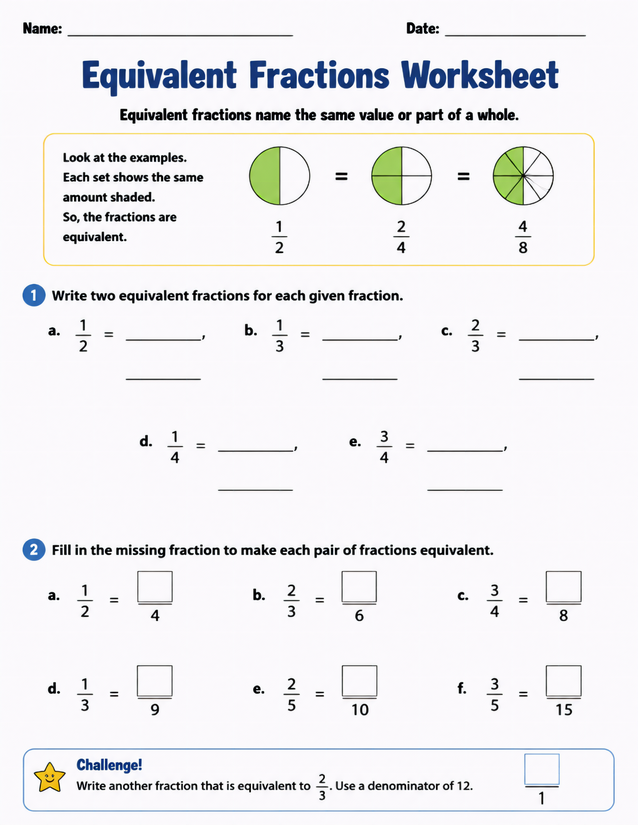
Sharpen fraction fluency with this equivalent fractions worksheet for grades 3 to 4, covering writing and finding missing numerators.
Working Through an Equivalent Fractions Worksheet in Two Formats

Usage Notes
Pencil suits this worksheet well since students may need to scratch out a multiplication step before committing an answer to the blank. Both sections work for independent practice once your homeschooler understands the concept of multiplying numerator and denominator by the same number, though the challenge problem at the bottom benefits from a quick guided conversation first.

Printing Tips
Standard 20 lb copy paper works fine here since the activity is pencil-based and does not require heavy coverage. Portrait orientation is the correct setting, and printing a small set of two or three copies gives your student room to retry section two if they work through it more than once during the unit.