Creative Minds 𖹭 Happy Hearts

Observing the Feeding Habits of Earthworms, Homeschool Science Experiment
Six to ten earthworms and a handful of kitchen scraps are all it takes to run a real feeding habits of earthworms experiment your student will still talk about a week later.
This lab sheet walks your student through a structured 24-hour observation of the feeding habits of earthworms, specifically testing whether they prefer fruit, carrot, leaf litter, coffee grounds, or plain oatmeal. Students write a hypothesis first, then record after-results in a table that tracks where each worm was found: on, near, or not near each food type. Three analysis questions push them to interpret patterns and connect their findings to how earthworms behave in natural soil. Designed for grades 3-6, it suits a life science or soil ecology unit study equally well.
The sheet works as a standalone one-session setup with a 24-hour wait, but it also fits naturally into a longer unit on decomposers, soil health, or invertebrate behavior. A note at the bottom of the sheet reminds students that earthworms break down organic matter and support the ecosystem, which gives you an easy bridge to a follow-up lesson on composting or the nutrient cycle. Completing the sheet shows your homeschooler can form a testable hypothesis, observe animal behavior methodically, and draw evidence-based conclusions.
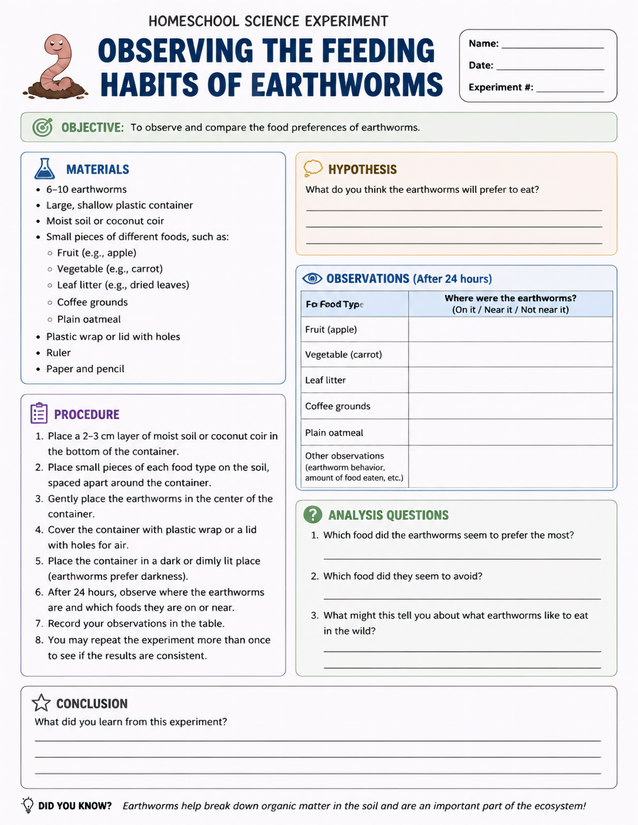
Compare food preferences using this feeding habits of earthworms lab sheet, ideal for grades 3-6 homeschoolers. Download and print instantly.
Investigating the Feeding Habits of Earthworms in Your Backyard

Usage Notes
Everything on the materials list is either a household item or easy to source for free outdoors. The only supplies needed are 6-10 earthworms dug from garden soil, a large shallow plastic container, moist soil or coconut coir, and small pieces of apple, carrot, dried leaves, coffee grounds, and plain oatmeal. No safety hazards are implied beyond basic hand-washing after handling worms and soil, which is worth mentioning to younger students before they start.
Printing Tips
A 20 lb copy paper works fine here since students write observations after the 24-hour wait rather than in the middle of messy setup. Slide the sheet into a clipboard kept near the container so it stays accessible for the follow-up recording step, or tuck it into a dedicated science lab notebook alongside the hypothesis draft.