Creative Minds 𖹭 Happy Hearts

Fish Growth Rates in Different Water Temperatures Lab Sheet
Four weeks, three tanks, three temperatures: tracking fish growth rates in different water temperatures teaches your student what controlled variables actually mean in practice.
Across four weeks, your student records fish length in millimeters across three tanks held at cold (18-20°C), room temperature (24-26°C), and warm (28-30°C) conditions. The lab sheet walks through the full scientific method, from forming a hypothesis about fish growth rates in different water temperatures to completing a structured data table with weekly measurements and behavioral observations, making it well suited for grades 5-7 homeschoolers building data literacy alongside life science concepts.
This experiment works well as a standalone unit or as part of a broader aquatic biology or ecology study. Your student demonstrates understanding of controlled variables, consistent measurement technique, and evidence-based reasoning by writing a conclusion that begins with the sheet’s guided prompt. The analysis section pushes beyond data recording, asking your homeschooler to explain why temperature affected growth and what they would change if they ran the experiment again.
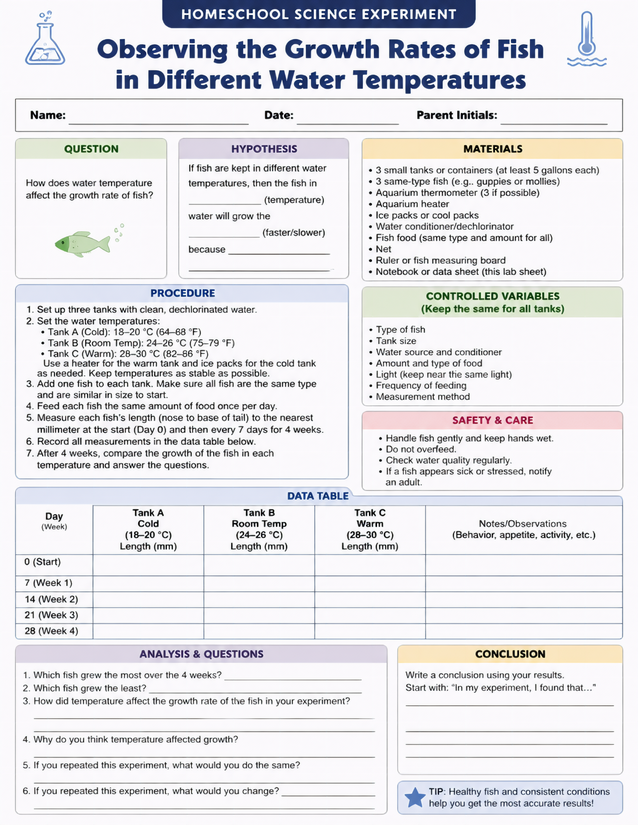
Track fish growth rates in different water temperatures across four weeks. Designed for grades 5-7 homeschoolers, this lab includes a full data table.
Setting Up Your Fish Growth Rates in Different Water Temperatures Experiment

Usage Notes
Three tanks of at least five gallons each are the biggest commitment here. The sheet calls for an aquarium heater, ice packs or cool packs, a thermometer, water conditioner, fish food, a net, and a ruler or fish measuring board. Live fish make this a longer-term care responsibility, so walk your student through the safety and care section before starting, which specifically notes handling fish gently, not overfeeding, and notifying an adult if a fish appears stressed.

Printing Tips
A single sheet on 24 lb paper holds up better on a clipboard beside a wet tank than standard copy paper, which wrinkles when hands are damp. Slip completed weekly rows into a lab notebook as a running record, or print five copies at the start so your student always has a fresh data table ready at observation time.