Creative Minds 𖹭 Happy Hearts

Fractions Introduction Worksheet, Shading and Naming Basic Fractions
Four exercises, one page, and your student moves from ‘what is a fraction?’ to identifying, shading, writing, and comparing them. A fractions introduction worksheet rarely packs this much ground into a single sitting.
This fractions introduction worksheet opens with a definition box explaining numerator and denominator using a/b notation, paired with a shaded circle showing one-fourth. From there, four exercises build in sequence: students identify fractions from shaded circle and rectangle models, shade blank shapes to match given fractions, write fractions such as 1/2 and 3/4 in words, then circle all fractions less than one whole from a final boxed set. It suits grades 2 through 4, depending on where your homeschooler is in their math sequence.
Add this fractions introduction worksheet to a unit study on number sense or pull it out as a standalone lesson introduction. The layout moves from visual recognition to abstract writing, so students are not just memorizing vocabulary but connecting symbols to pictures to language. Most students can work through sections one and four independently once you walk through the definition box together.
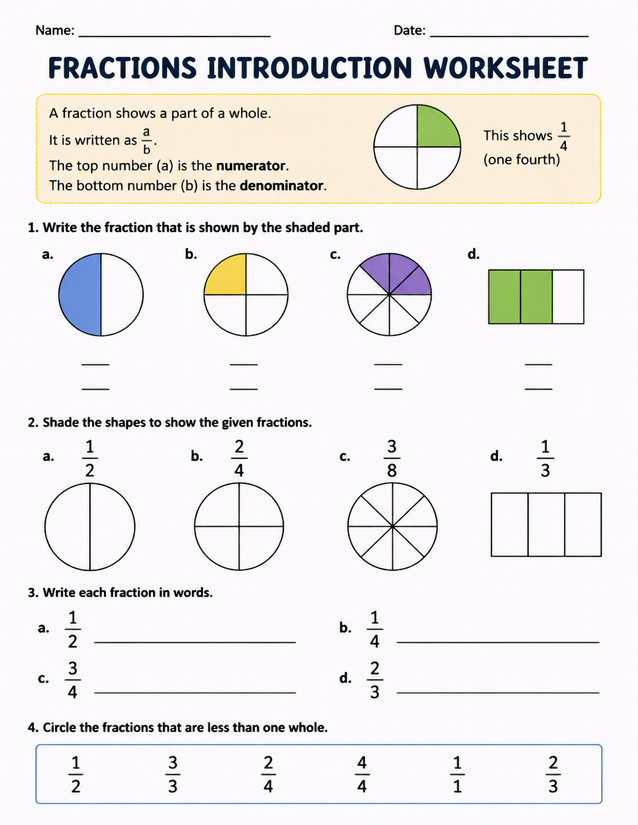
A fractions introduction worksheet covering numerators, denominators, and shading for grades 2-4. Instant download, ready to print.
Getting Started with a Fractions Introduction Worksheet
Usage Notes
A pencil works best here because section two asks students to shade shapes, and light pencil strokes are easier to correct than marker. Sections one and three are purely written responses, manageable for independent practice once the vocabulary is introduced. Guided instruction is recommended for the first pass through the definition box.
Printing Tips
Standard copy paper is fine for all four exercises since no coloring is required. Portrait orientation matches the layout exactly, and printing two or three copies lets your student revisit the shading section on separate attempts without running out of blank shapes.