Creative Minds 𖹭 Happy Hearts

Fruit and Vegetable Sort and Group Worksheet, Color and Size
Sixteen kawaii fruits and vegetables are waiting to be sorted by color AND arranged from smallest to biggest on this fruit and vegetable sort and group worksheet, so there are actually two skills packed onto one page.
Section one, Sort by Color, presents five labeled columns outlined in red, yellow, green, orange, and purple. Below those columns sits a dashed grid of sixteen kawaii produce icons including cherries, red pepper, strawberry, banana, lemon, corn, pea pod, green apple, broccoli, cucumber, carrot, pumpkin, eggplant, fig, onion, and grapes, which children draw or write into the matching column. Section two, Sort by Size, gives three rows anchored by a colored reference image on the left, one each for apple, banana, and carrot, followed by four dashed empty boxes connected by arrows, prompting kids to order the same item from smallest to biggest.
This fruit and vegetable sort and group worksheet suits early learners practicing both classification and size sequencing without needing to flip between multiple sheets. It sits naturally inside a homeschool morning basket or a pre-K classroom center, and a cheerful star with the prompt “Great job! You’re a sorting superstar!” at the bottom keeps the mood light. The two distinct sections mean the page can be worked across a single sitting or split across two short lessons.
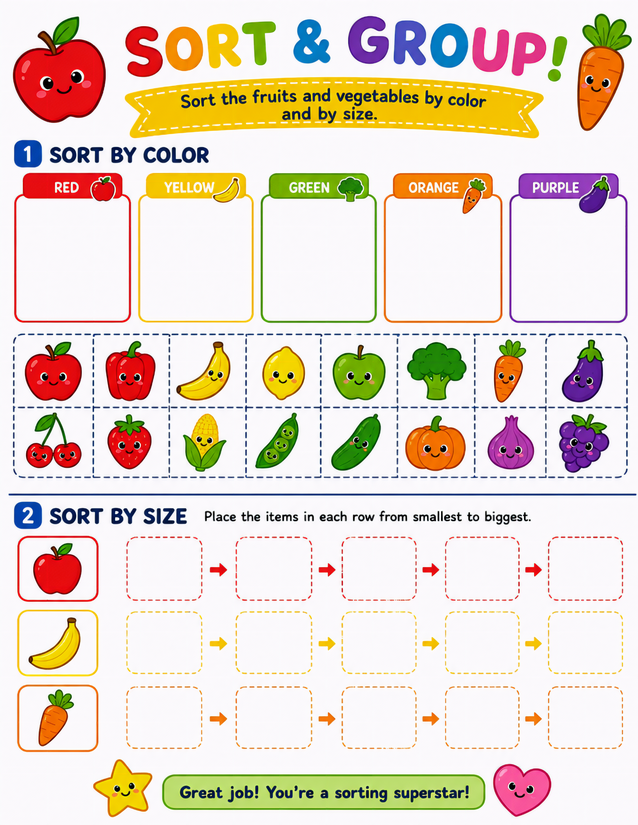
Sixteen kawaii fruits and vegetables make this fruit and vegetable sort and group worksheet a cheerful two-skill early math activity. Free instant download.
Making the Most of Your Fruit and Vegetable Sort and Group Worksheet

Usage Notes
Gel pens or washable markers suit the five color-sort columns well since each box is wide enough for a quick sketch or a written name. The size-sequencing boxes in section two are dashed-border squares, roomy enough for a small drawn image but snug for any writing longer than a single word, so a thin-tipped marker or a sharpened pencil keeps things tidy. Laminate a copy and the whole sheet becomes a dry-erase center activity kids can reset and repeat.

Printing Tips
Standard 20 lb copy paper works fine for single use, but 32 lb paper holds up better if children are pressing hard with markers in the larger color columns. Print single-sided so the dashed icon grid on the front does not ghost through to the back when kids are referencing it during the size-sort section.