Creative Minds 𖹭 Happy Hearts

Growing a Mini Ecosystem in a Sealed Jar, Step by Step
Layered gravel, soil, moss, and a sealed lid, and suddenly your student is running a self-contained water cycle. Growing a mini ecosystem in a sealed jar turns a mason jar into a living science lesson.
Growing a mini ecosystem in a sealed jar is the central experiment on this lab sheet, designed for homeschoolers in grades 3 to 6. The sheet walks your student through a 12-step procedure covering drainage layers, soil depth, plant placement, and misting, then asks them to record changes over time in a dated observation table with columns for visual changes, new observations, and questions. A background section explains the water cycle happening inside the jar, and a reflection prompt at the bottom asks students to articulate how the parts of the ecosystem work together.
This lab sheet fits naturally into a life science or ecology unit study, either as a standalone multi-day observation project or as the hands-on anchor for a broader unit on ecosystems, water cycles, or plant biology. Completing the observation table and reflection demonstrates that your student can connect a visible process to an underlying scientific concept, making it a strong evidence piece for a science portfolio.
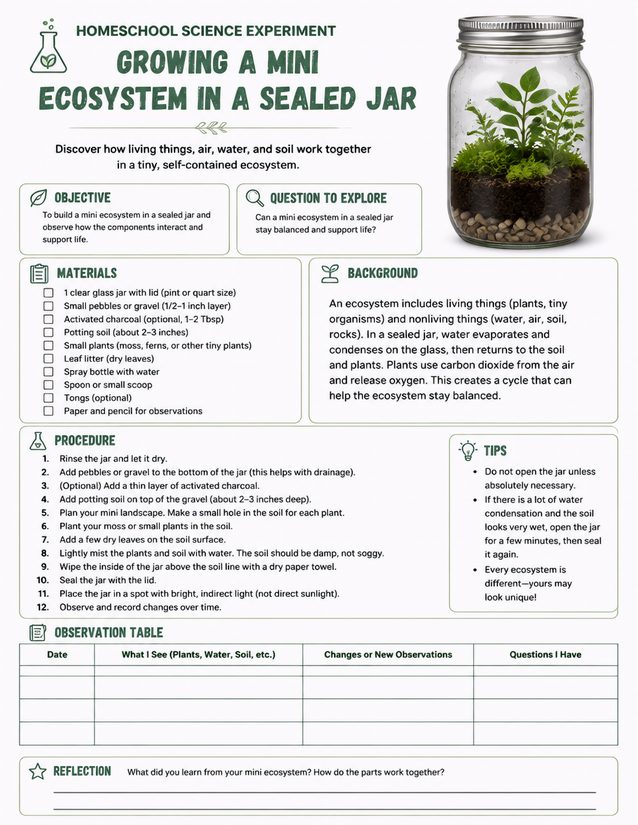
Grades 3 to 6 will love growing a mini ecosystem in a sealed jar with this detailed homeschool science experiment sheet. Download it free.
Exploring Growing a Mini Ecosystem in a Sealed Jar

Usage Notes
Gravel, potting soil, a glass jar with a lid, and small plants like moss or ferns are the core materials, all of which are household or garden-center finds. Activated charcoal is listed as optional but worth picking up from a pet supply store if condensation management matters to your homeschool setup. No heat or chemical safety concerns here, though the sheet reminds students to keep the jar sealed and to open it only briefly if excess condensation appears.

Printing Tips
Standard 20 to 24 pound copy paper works fine for the observation table, but if your student will be checking and filling in the sheet repeatedly over several days, cardstock keeps the page from warping on a clipboard next to the jar. Punch and insert it into a science notebook so dated observations stay in sequence with lesson notes.