Creative Minds 𖹭 Happy Hearts

Growing a Terrarium with Moss and Small Plants, Homeschool Lab Sheet
Layering gravel, charcoal, and potting soil into a jar teaches ecosystems far better than any textbook page. Growing a terrarium with moss lets your student watch the water cycle happen right on the windowsill.
This lab sheet walks your homeschooler through building a closed mini ecosystem, starting with a gravel drainage layer and optional activated charcoal, then potting soil, moss, and small plants like fittonia, baby tears, or fern. The observation table asks students to log the date, what they see inside the jar, how much water was added, and any changes noticed, building a multi-week data record. The sheet is well-suited for grades 3 through 6 and fits naturally into a life science, ecology, or plant biology unit.
Growing a terrarium with moss gives your student a concrete model of evaporation, condensation, and water collection in a closed system, concepts the sheet reinforces through five written reflection questions about the water cycle and the role of the lid. A “Think Like a Scientist” prompt at the bottom frames the terrarium as a closed ecosystem and asks students to draw conclusions from their own observations. The sheet works as a standalone project or as the capstone of a broader ecosystems unit study.
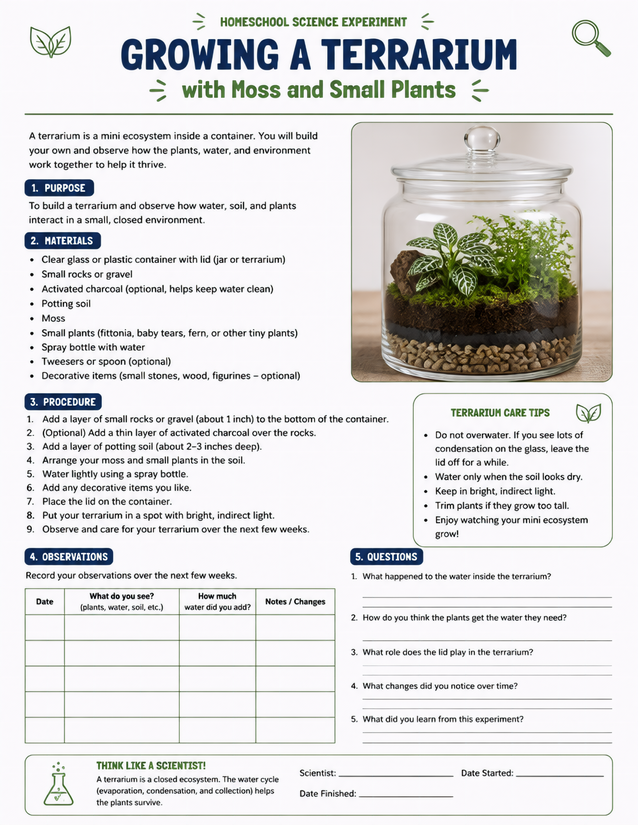
Grades 3 through 6 will love growing a terrarium with moss, fittonia, and fern in this hands-on homeschool science experiment sheet.
Getting Started with Growing a Terrarium with Moss

Usage Notes
Rocks or gravel, potting soil, and moss are the core materials, and all can be gathered from a garden center in a single trip. Activated charcoal is listed as optional but worth picking up if your student wants to keep the water clean long-term. Tweezers or a spoon help with planting in narrow-necked jars, and a spray bottle controls watering precisely enough that overwatering is easy to avoid.

Printing Tips
Plain copy paper works for a one-time build, but 24-pound paper handles the repeated handling of a multi-week observation log without the edges curling. Hole-punch the finished sheet and slip it into a science binder or nature journal alongside sketches your student makes of the terrarium each week.