Creative Minds 𖹭 Happy Hearts

Growing Bacteria from Different Locations in Your Home
Your kitchen counter, your phone screen, your doorknob: growing bacteria from different locations in your home turns everyday surfaces into a five-day science experiment worth remembering.
Your student swabs up to six household surfaces, including doorknobs, faucet handles, light switches, and phone screens, streaks each sample onto a labeled agar plate, and observes bacterial colony growth daily for three to five days. The observation table tracks plate number, location sampled, date, and daily notes across five columns, giving grades 4 through 7 a structured, repeatable way to compare microbial activity across high-touch and low-touch surfaces.
Growing bacteria from different locations sits naturally inside a microbiology unit study or a broader health and hygiene sequence. It works as a standalone multi-day investigation too, since the analysis questions push your student to explain why some surfaces harbor more bacteria, which surfaces showed the least growth, and how household hygiene habits connect to what they actually observed. Completing the draw-your-results section asks them to sketch and label colony types, moving the lesson from passive recording into scientific illustration.
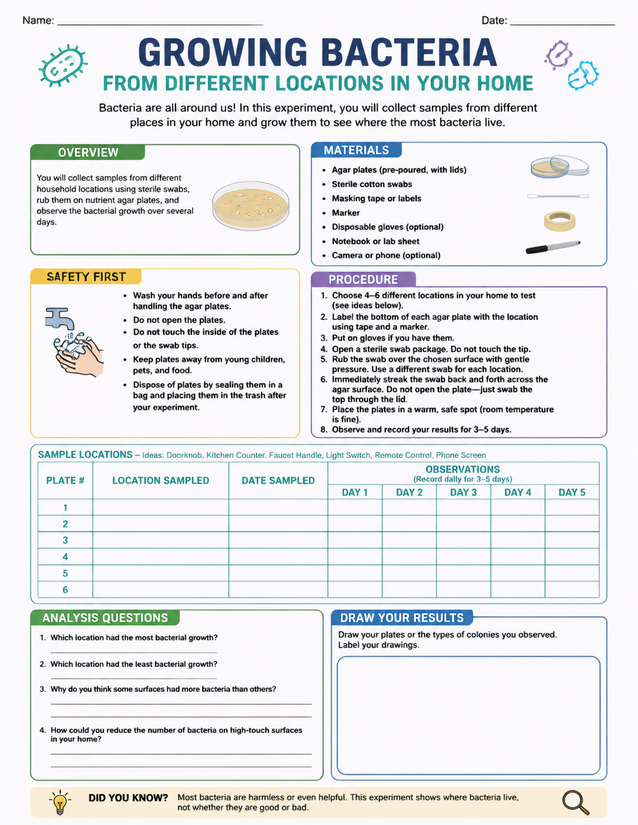
Six household surfaces, one agar plate each: this growing bacteria from different locations lab sheet suits grades 4 through 7 perfectly.
Setting Up Growing Bacteria from Different Locations

Usage Notes
Pre-poured agar plates with lids are the one specialty item here; everything else, sterile cotton swabs, masking tape, a marker, and optional disposable gloves, is easy to source from a pharmacy or online. The sheet includes a dedicated Safety First section covering handwashing, keeping plates sealed throughout the observation period, and proper disposal by sealing used plates in a bag before trashing. Keep plates away from young children and pets for the duration of the experiment.

Printing Tips
A single loose sheet on a clipboard keeps the observation table accessible during daily check-ins without crowding a lab notebook. Heavier 24-pound paper holds up better if the sheet gets handled repeatedly over five days, but standard copy paper works fine if it stays flat on a desk.