Creative Minds 𖹭 Happy Hearts

Growing Bean Seeds in Different Soil Types, 14-Day Lab Sheet
Four pots, four soils, one question worth answering over two weeks. This growing bean seeds in different soil types lab walks your student through a controlled comparison that makes soil science tangible.
The experiment asks one focused question: how do different soil types affect bean seed growth? Your student plants three seeds each into potting soil, clay soil, sandy soil, and compost or rich organic soil, then measures sprout height from soil surface to tallest sprout at Day 0, Day 3, Day 7, Day 10, and Day 14. The observation table also prompts notes on leaf size, color, and sprout count, so the data set is genuinely comparative. Suited for grades 3 through 5, this growing bean seeds in different soil types lab sheet pairs naturally with a plant biology or earth science unit.
Used standalone, it teaches controlled variables through the constraint of identical watering amounts and sunlight placement. Inside a longer unit study, it builds directly from lessons on soil composition and leads into discussions of agriculture, drainage, and nutrient density. The conclusion section asks which soil grew the tallest plants, which grew the healthiest, and what the student would change in a follow-up experiment, making it a complete scientific cycle rather than just a data table.
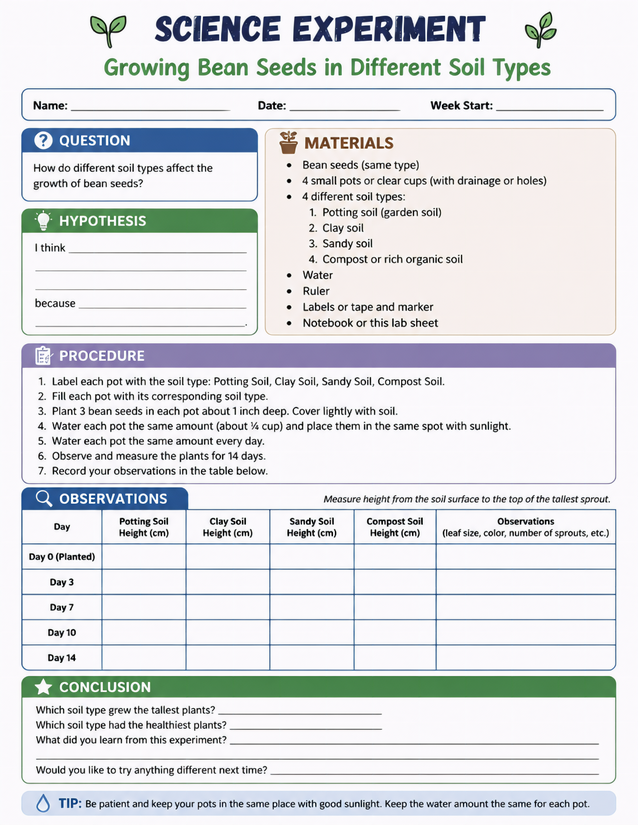
Compare potting, clay, sandy, and compost soils with this growing bean seeds in different soil types worksheet for grades 3 through 5.
Investigating Growing Bean Seeds in Different Soil Types

Usage Notes
All four soil types are household or garden-center staples: potting soil, clay soil, sandy soil, and compost. Beyond that, the sheet calls for four small pots or clear cups with drainage holes, a ruler, water measured to one-quarter cup per watering, and labels or tape with a marker. No specialty supplies, no safety concerns beyond basic handwashing after handling soil.

Printing Tips
Copy paper handles this one fine for a loose sheet on a clipboard near the growing area, but 24-pound paper is worth it if your student plans to press hard on the ruler measurements. Punching holes and inserting it into a science lab notebook keeps fourteen days of data organized and easy to review at the conclusion stage.