Creative Minds 𖹭 Happy Hearts

Growing Bean Sprouts in a Jar, Homeschool Science Lab Sheet
Mung beans soaked overnight, a cheesecloth lid, and seven days of rinsing twice a day: growing bean sprouts in a jar is one of those experiments where the results are edible and the science is genuinely visible.
Growing bean sprouts in a jar gives students in grades 2 through 5 a front-row seat to germination and plant growth without soil, grow lights, or waiting weeks for results. The sheet walks your student through a written hypothesis, a seven-day observation table with columns for what they see, a hand-drawn picture, and notes or measurements, then closes with four reflection questions and a conclusion where they circle whether their hypothesis was correct.
This homeschool worksheet fits naturally into a plant biology unit study or a life science sequence covering seeds, germination, and what plants need to grow. A student who completes it can describe how a seed changes day by day, explain why rinsing matters, and connect their hypothesis to their actual data. The sheet stands alone as a week-long project or pairs with a soil-based bean experiment for a direct comparison of growing conditions.
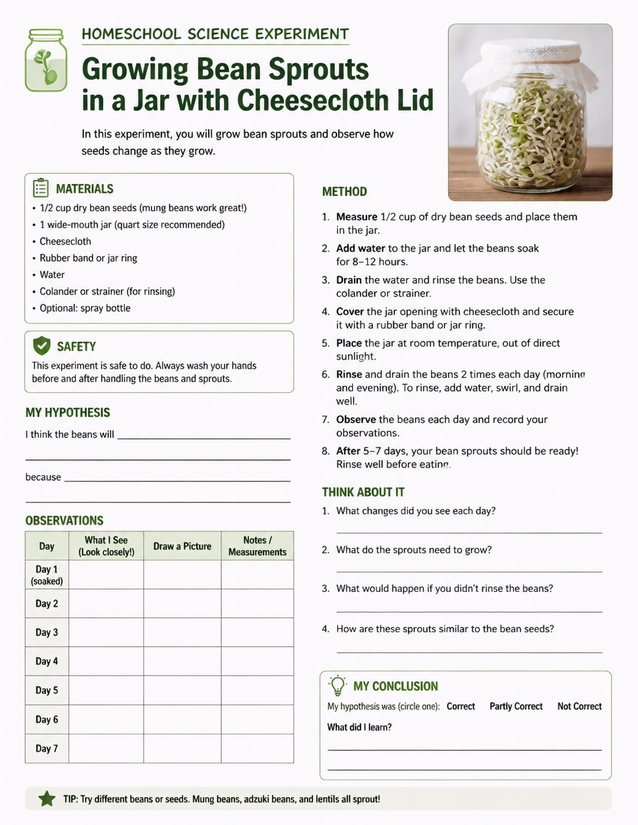
Grades 2 through 5 will love this growing bean sprouts in a jar experiment. Seven days of daily observations, hypothesis, and conclusion included.
Investigating Growing Bean Sprouts in a Jar, Day by Day

Usage Notes
Every material on this sheet is a household item: dry mung beans, a wide-mouth quart jar, cheesecloth, a rubber band, and a colander for rinsing. No specialty supplies are needed, which makes this easy to start on short notice. The safety section reminds students to wash hands before and after handling the beans and sprouts, worth a quick read-aloud before day one.

Printing Tips
A loose sheet on a clipboard works well here since your student returns to it twice a day for rinsing observations. Twenty-four-pound paper gives the observation table enough body to write on repeatedly without the sheet buckling, and the columns are wide enough for small sketches.