Creative Minds 𖹭 Happy Hearts

Growing Carnivorous Plants Venus Flytraps Lab Sheet
Red-rimmed trap jaws, trigger hairs, and a bug that never saw it coming. Growing carnivorous plants venus flytraps turns a two-to-four-week observation into one of the most memorable units on your shelf.
Your student begins by forming a hypothesis about the conditions that help Venus flytraps grow and catch insects, then sets up a controlled experiment tracking natural light versus grow light over two to four weeks. The sheet walks grades 4 through 7 through independent, dependent, and controlled variables before any soil goes into a pot, which is exactly the kind of scientific thinking this homeschool worksheet is designed to build.
The growing carnivorous plants venus flytraps experiment fits naturally into a botany unit study or a broader life science sequence covering plant adaptations and carnivory. Your homeschooler records daily observations in a structured data table, noting new trap growth, hours of light, and whether a trap closed on an insect, then draws conclusions about what conditions produced the healthiest plant. Completing the sheet demonstrates hypothesis writing, variable control, and evidence-based reasoning all from a single living specimen on the windowsill.
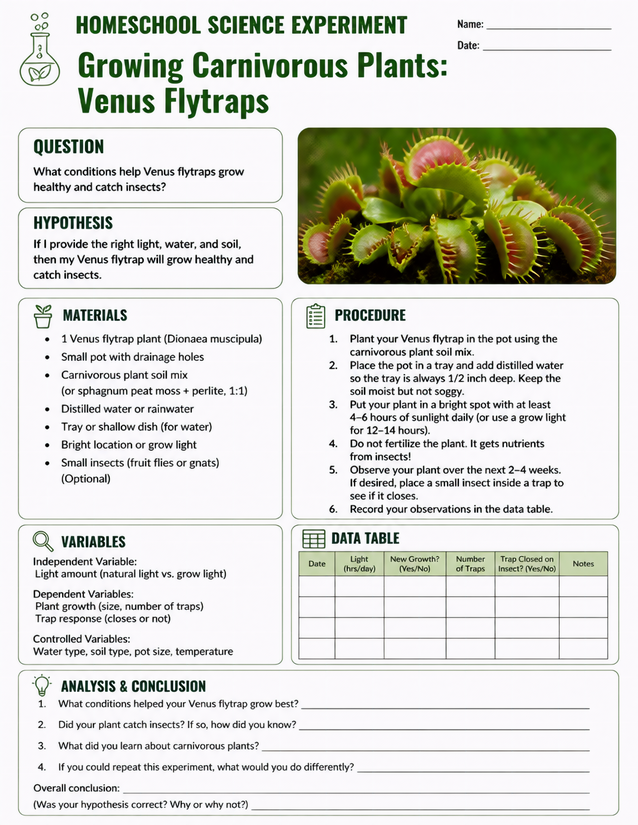
Grades 4 through 7 will love growing carnivorous plants venus flytraps with this structured homeschool science experiment recording sheet.
Investigating Growing Carnivorous Plants Venus Flytraps at Home

Usage Notes
Distilled water or rainwater is listed specifically because tap water can harm flytraps, so flag that detail for your student before setup. The soil mix calls for carnivorous plant mix or sphagnum peat moss plus perlite at a 1:1 ratio, which is a specialty supply most garden centers carry in spring. Small insects such as fruit flies or gnats are listed as optional, but handle live insects with care and wash hands after any contact with the trap.

Printing Tips
Slip a single sheet onto a clipboard near the plant so your student can log observations without moving the pot. Standard 20-pound copy paper works here since the data table uses brief entries, but stepping up to 24-pound paper prevents bleed-through if your student uses a felt-tip pen for daily notes.