Creative Minds 𖹭 Happy Hearts

Growing Cress Seeds on Different Surfaces, 7-Day Lab Sheet
Cotton, sponge, or potting soil: growing cress seeds on different surfaces turns a simple tray setup into seven days of real data your student collects themselves.
This lab sheet guides your student through a structured comparison of cress seed germination across three surfaces: cotton, sponge, and potting soil. Your homeschooler fills in a hypothesis before the experiment begins, then tracks average plant height in centimeters for each surface every day for seven days, noting leaf color and density in a dedicated observations column. The sheet is well-suited for grades 2 through 5 and gives younger students a first taste of controlled variables without overwhelming them.
Growing cress seeds on different surfaces fits naturally into a plants and living things unit study or a broader botany sequence. It works as a standalone week-long investigation or as a companion to lessons on what seeds need to germinate. By the time your student reaches the conclusion section, they are drawing evidence-based claims from their own recorded data, which is a foundational science skill this sheet asks them to practice explicitly.
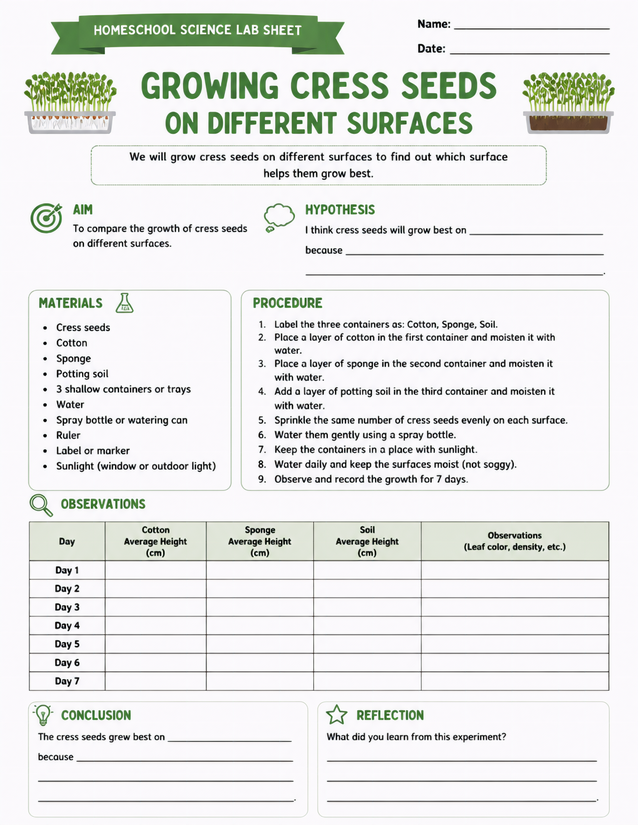
Compare cotton, sponge, and soil with this growing cress seeds on different surfaces homeschool lab sheet for grades 2 through 5.
Setting Up Growing Cress Seeds on Different Surfaces

Usage Notes
Cotton, sponge, and potting soil are the three surfaces being compared, and all are household or easily sourced materials. Your student will also need three shallow containers or trays, a spray bottle or watering can, a ruler, and a label or marker for the containers. No safety concerns are implied beyond keeping the setup near a window with consistent sunlight and making sure surfaces stay moist rather than waterlogged.

Printing Tips
Standard copy paper is fine for the observation table, but 24-pound paper holds up better if your student is filling in measurements with a damp ruler nearby. Slip the sheet into a plastic page protector inside a lab notebook to protect it across the full seven-day recording period.