Creative Minds 𖹭 Happy Hearts

Growing Crystals from Different Mineral Solutions, Lab Sheet
Epsom salt, table salt, baking soda: three jars, three minerals, and fourteen days of data. Your student will find out which one growing crystals from different mineral solutions produces fastest.
Structured for grades 4-7, this lab sheet walks your homeschooler through a fourteen-day comparison of crystal formation across three saturated mineral solutions. Your student measures crystal length in millimeters each day, records the data in a labeled observation table, and sketches the crystals on Day 1 and Day 14 so shape and color changes are documented visually alongside the numbers. The growing crystals from different mineral solutions experiment wraps up with five reflection questions that ask which solution produced the largest crystals, which made the most, how the shapes compared, what caused the differences, and what your student would try next.
This lab fits cleanly into an earth science or chemistry unit study on solutions, evaporation, and mineral properties. It works as a standalone two-week investigation or as a companion to a broader minerals and rocks unit. By the time your student submits the completed sheet, they have practiced daily scientific observation, consistent measurement, comparative data recording, and beginning-level scientific reasoning about cause and effect.
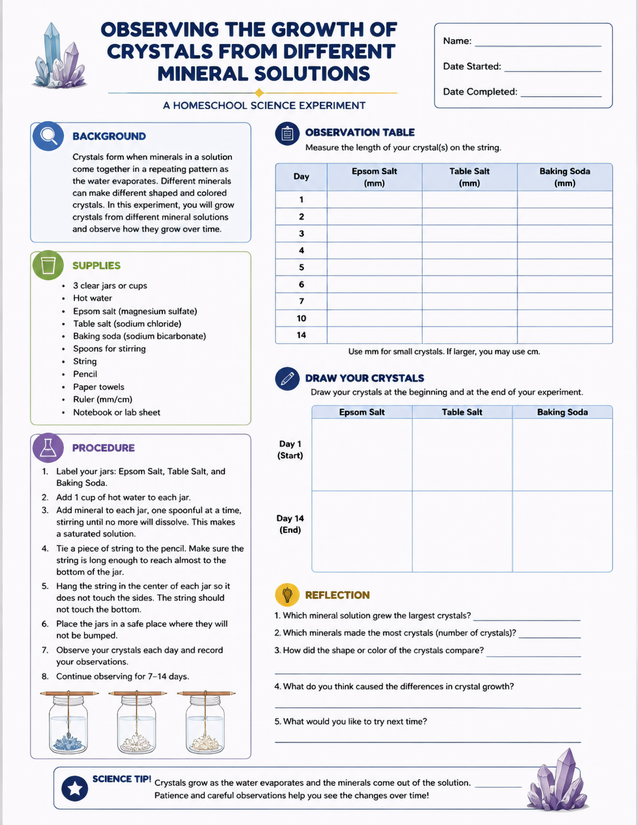
Compare Epsom salt, table salt, and baking soda with this growing crystals from different mineral solutions homeschool lab sheet for grades 4-7.
Investigating Growing Crystals from Different Mineral Solutions

Usage Notes
Hot water, string, a pencil, spoons, and three clear jars are the only containers needed, and all are standard household items. The minerals themselves, Epsom salt (magnesium sulfate), table salt (sodium chloride), and baking soda (sodium bicarbonate), come from a grocery store and cost very little. Hot water is the one safety consideration: supervise younger students when filling jars, and remind them the jars should be placed somewhere they will not be bumped for up to two weeks.

Printing Tips
Standard 20 lb copy paper is fine for daily recording since students are writing measurements, not pressing hard. Slip the sheet into a plastic page protector inside a lab notebook to keep it flat while the jars sit nearby for daily checks, or use a clipboard if your student prefers to record at the jar location.