Creative Minds 𖹭 Happy Hearts

Growing Crystals from Salt or Sugar Solutions Lab Sheet
Growing crystals from salt or sugar solutions turns a mason jar and a piece of string into a five-day science experiment your student can watch change every single morning.
This lab sheet guides students through the full cycle of crystal formation, from creating a saturated solution to suspending a string in the jar and recording daily observations over five or more days. Students in grades 3 through 6 document what they see each day in an observations section that includes a drawing box for sketching crystal growth, then answer three structured reflection questions about what happened to the dissolved substance, how the crystal grew, and what the experiment revealed. The sheet covers the core concept that crystals form as water evaporates and particles arrange into ordered patterns, making it a clear, hands-on entry point into solubility and states of matter.
Growing crystals from salt or sugar fits naturally into a unit study on chemistry, matter, or earth science, and the multi-day format makes it an ideal anchor experiment for a week-long lesson block. It works as a standalone activity or alongside reading on mineral formation and geology. A student who completes it demonstrates the ability to maintain a multi-day observation log, form a basic conclusion from experimental evidence, and connect a visible result to an underlying chemical process.
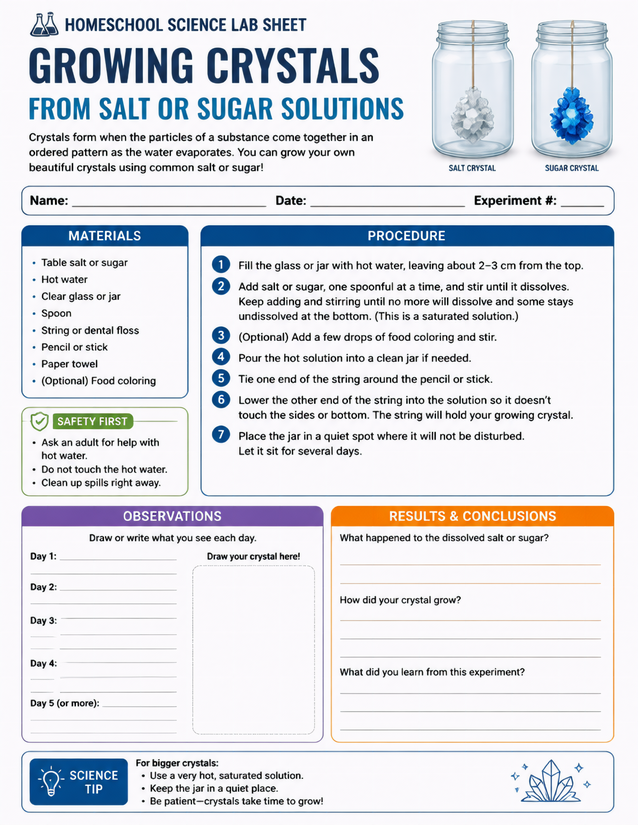
Watch solubility science happen over days: growing crystals from salt or sugar solutions suits grades 3 through 6 homeschoolers beautifully.
Getting Started with Growing Crystals from Salt or Sugar

Usage Notes
Every item on the materials list is a household supply: table salt or sugar, hot water, a clear glass or jar, a spoon, string or dental floss, a pencil or stick, a paper towel, and optional food coloring. No specialty supplies are needed. The sheet includes a Safety First callout reminding students to ask an adult for help with hot water and to avoid touching it directly, so plan to supervise the solution-making step closely.

Printing Tips
Cardstock is not ideal here since students write daily entries across five or more days and may carry the sheet back and forth to check the jar. A single 24-pound sheet holds up to repeated handling better than standard copy paper, and slipping it into a page protector inside a lab notebook keeps it flat and protected without laminating.