Creative Minds 𖹭 Happy Hearts

Growing Dwarf Pea Plants and Observing Mendelian Genetics
Mendel figured out inheritance by watching peas. Your student can do the same with this growing dwarf pea plants lab sheet, tracking real crosses across three generations.
This lab sheet guides students through Gregor Mendel’s foundational genetics experiment: planting homozygous dwarf (TT) and tall (tt) pea seeds in separate pots, crossing the flowering plants by hand, and growing the F1 and optional F2 generations. Students measure and record plant height weekly, transfer pollen using a small paintbrush or cotton swab, and fill in a structured data table noting the number of dwarf and tall offspring and the dwarf-to-tall ratio for each generation. A genetics note box explains dominant and recessive alleles clearly, making this accessible for grades 5 through 8 working on heredity and inheritance.
The growing dwarf pea plants lab sheet works well as the centerpiece of a genetics unit study or as a standalone multi-week experiment that runs alongside other biology topics. Four written analysis questions at the bottom ask your student to explain phenotypes, predict outcomes, interpret ratios, and connect their results to Mendel’s law of segregation, moving the work from observation into scientific reasoning.
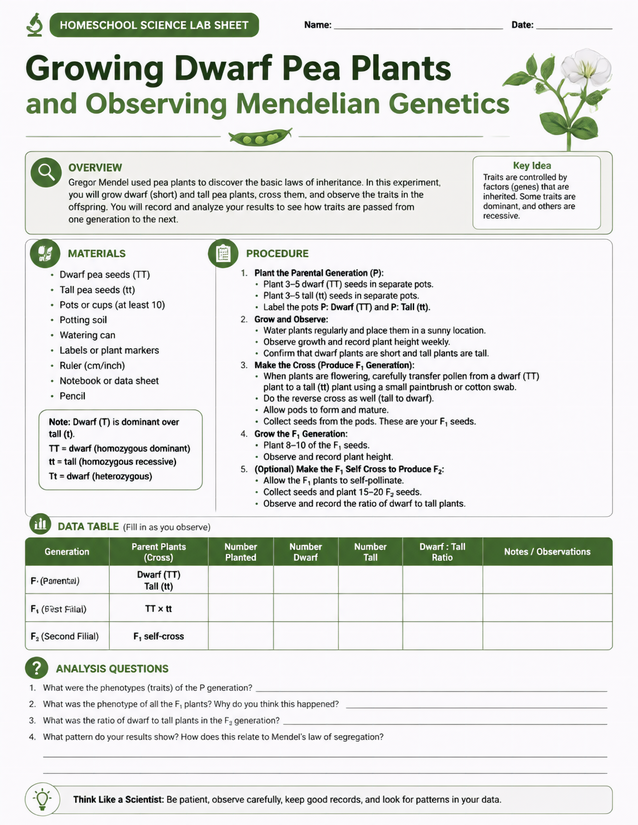
Replicate Mendel’s classic experiment with this growing dwarf pea plants lab sheet, suited for grades 5 through 8. Instant download.
Exploring Growing Dwarf Pea Plants Lab Sheet Across Three Generations

Usage Notes
Dwarf pea seeds labeled TT and tall pea seeds labeled tt are the specialty items to source before starting. Everything else, including pots or cups, potting soil, a watering can, labels, a ruler, and a pencil, is likely already on hand. The cross-pollination step uses a small paintbrush or cotton swab, so no specialty lab tools are needed, though adult supervision during the pollination transfer is a good practice to discuss with your student beforehand.

Printing Tips
Twenty-pound copy paper works for this sheet, but 24-pound holds up better if your student is recording observations at a table near the plants over several weeks. Insert the completed sheet into a science lab notebook beside weekly height measurements to build a tidy genetics record.