Creative Minds 𖹭 Happy Hearts

Growing Garlic in a Window Box, Observing Bulb Formation
Garlic takes months to mature, and growing garlic in a window box gives your student a front-row seat to every stage, from first shoot to harvested bulb.
Growing garlic in a window box turns a kitchen staple into a semester-long science investigation for grades 3 through 6. The sheet opens with the guiding question of how bulbs form underground, walks students through an eight-step procedure, and provides a structured observation table where they log the date, days since planting, shoot height in centimeters, visible leaf and color changes, and any sketches or notes. A dedicated results box asks students to describe their harvested bulbs, and the conclusion section prompts them to evaluate their original hypothesis.
This homeschool worksheet fits naturally into a plant biology unit study, a botany sequence, or a standalone long-term observation project. Because the experiment runs four to six months from planting to harvest, it builds habits of consistent scientific recording that a single-session lab cannot. A student who completes this sheet demonstrates understanding of bulb propagation, plant response to light and water, and the relationship between above-ground growth and underground development.
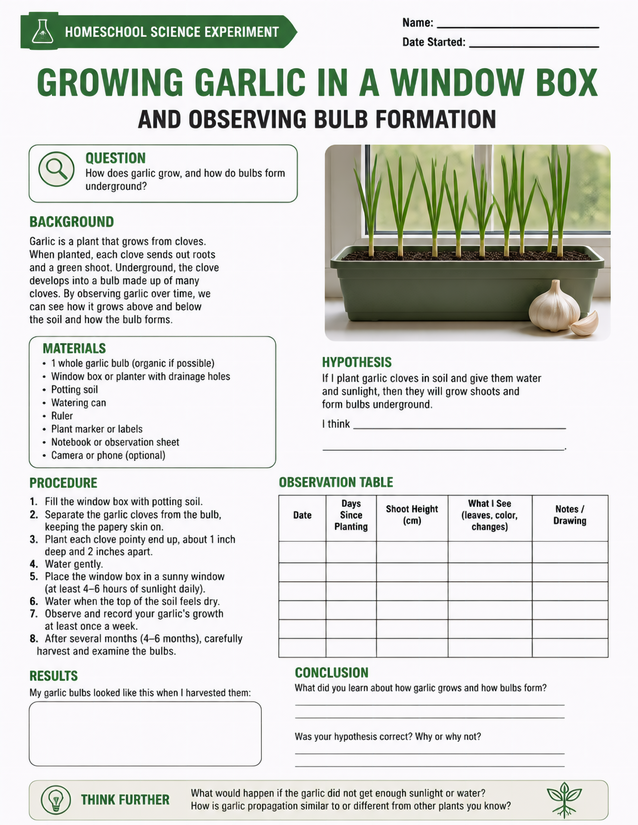
Grades 3 through 6 will love growing garlic in a window box while tracking shoot height and bulb formation week by week.
Investigating Growing Garlic in a Window Box Week by Week

Usage Notes
Every material on this sheet is a household or garden-center item: a whole garlic bulb, potting soil, a window box with drainage holes, a watering can, a ruler, and a plant marker. No specialty supplies are needed, which makes setup straightforward. The procedure notes to keep the papery skin on each clove when planting, so review that step with your student before you begin.

Printing Tips
A single copy on standard 20-pound paper works fine tucked into a science binder or lab notebook, where your student can flip back to earlier entries while adding a new weekly row. If you want the observation table to survive months of handling and the occasional watering-can splash, printing on 32-pound paper or sliding the sheet into a plastic page protector is worth the extra step.