Creative Minds 𖹭 Happy Hearts

Growing Marigolds and Studying Their Pest-Repelling Properties
Marigolds have a reputation as natural pest deterrents, but reputation is not data. Your student can test that claim directly with this growing marigolds pest repelling experiment recorded across three weeks.
Designed for grades 5 through 7, this lab sheet walks your homeschooler through a controlled garden experiment comparing two plant groups: Group A grown alongside marigolds and Group B grown without. Students count and record pest numbers on their target plants every two to three days over a 21-day period, tracking aphids, caterpillars, beetles, or slugs in a structured data table that calculates the difference between groups. The hypothesis section asks students to predict whether marigolds will reduce pest counts before a single seed goes in the ground.
This growing marigolds pest repelling experiment works well as a standalone biology unit or within a broader botany or garden science study. Because it runs over several weeks, it naturally reinforces observation habits and data consistency, two skills your student demonstrates explicitly in the conclusion section by evaluating whether the results supported their original hypothesis. Extension ideas on the sheet invite testing different target plants or varying the number of marigolds planted, giving you room to extend the unit if your homeschooler wants to keep going.
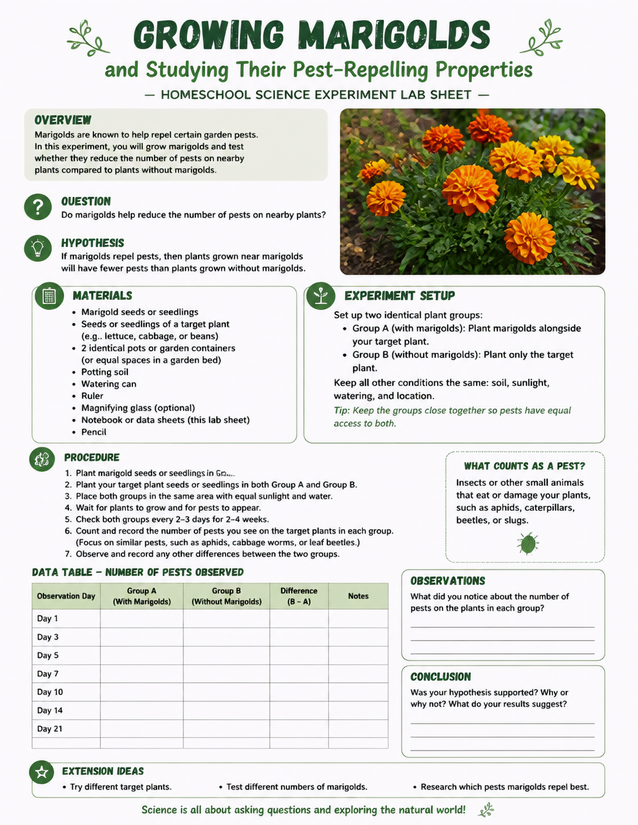
Does planting marigolds actually reduce nearby pests? This growing marigolds pest repelling experiment lab sheet helps grades 5-7 find out.
Investigating the Growing Marigolds Pest Repelling Experiment

Usage Notes
Most materials here are household or garden-shed staples: two pots or garden bed spaces, potting soil, a watering can, a ruler, and a pencil. You will need to source marigold seeds or seedlings and a target plant such as lettuce, cabbage, or beans from a nursery or seed packet. A magnifying glass is listed as optional but genuinely useful for identifying small insects like aphids, and no hazardous materials are involved.

Printing Tips
Loose sheets on a clipboard work best here since your student will be filling in the data table outdoors over multiple weeks. Standard 20-pound copy paper is fine for pencil entries, but if you want something that holds up to garden humidity, 24-pound paper takes moisture better without warping.