Creative Minds 𖹭 Happy Hearts

Growing Nightshade Family Plants Lab Sheet, Tomato to Potato
Four plants, one family, and a lot of differences to explain. This growing nightshade family plants lab sheet walks your student through a real grow-and-compare experiment using tomatoes, bell peppers, eggplant, and potatoes.
Your student grows at least three Solanaceae plants side by side, then records leaf shape, stem texture, flower color and petal count, fruit or tuber type, and any other distinguishing features in a structured observation table. The sheet opens with two guiding questions about shared and unique features across the family, making it a strong fit for grades 4 through 7 working on plant biology, taxonomy, or life science units.
This growing nightshade family plants lab sheet works as a standalone multi-week project or as the hands-on anchor for a botany unit study. Students demonstrate comparative observation skills, scientific vocabulary for plant anatomy, and the ability to draw evidence-based conclusions by completing the three written prompts at the bottom. Because the experiment unfolds over several weeks as plants mature, it naturally builds habits of consistent weekly observation.
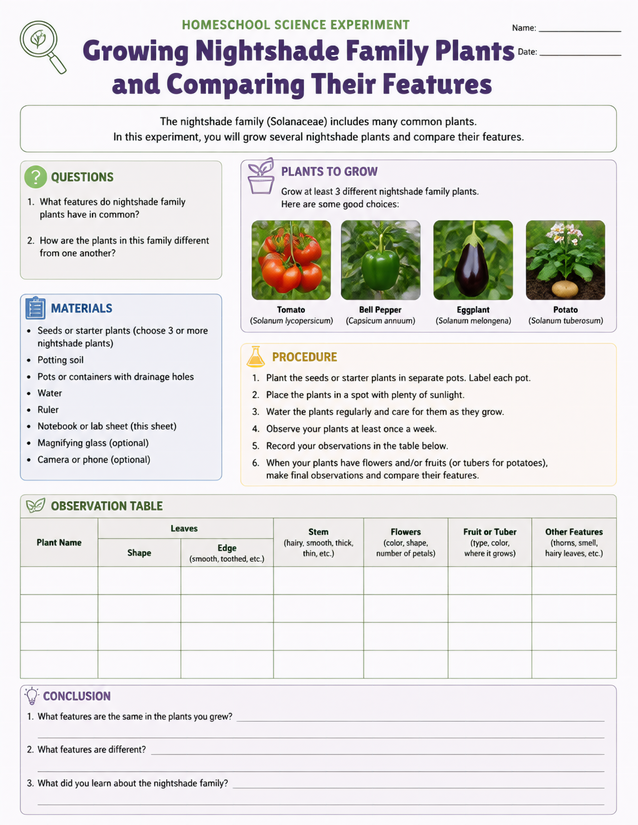
Compare tomatoes, bell peppers, eggplant, and potatoes with this growing nightshade family plants lab sheet for grades 4 to 7.
Setting Up the Growing Nightshade Family Plants Lab Sheet

Usage Notes
Seeds or starter plants for at least three Solanaceae varieties are the only specialty item here. Potting soil, containers with drainage holes, a ruler, and water are all household or easily sourced supplies. No chemicals or heat sources are involved, so this experiment is appropriate for independent student work with normal adult supervision for planting.
Printing Tips
Standard 20-pound copy paper is fine for most of the sheet, but if your student will be adding observations directly to the table over several weeks, 24-pound paper holds up better to repeated handling. Slip the sheet into a plastic page protector inside a science binder so it stays readable from week one through final harvest.