Creative Minds 𖹭 Happy Hearts

Growing Orchids from Seed on Agar, Sterile Culture Lab Sheet
Orchid seeds are so tiny they carry almost no nutrients of their own, and growing orchids from seed on agar is one of the few reliable ways to actually get them to germinate.
This lab sheet walks your student through the full asymbiotic germination process, from preparing and sterilizing the agar medium in a pressure cooker to sowing seeds onto the surface of culture jars and incubating them at 20 to 28 degrees Celsius. An observation table asks students to record date, days elapsed, visible changes in seed condition, color, and size, along with an optional sketch column and a notes field. Suited for grades 6 through 10, the sheet also logs Culture ID, Orchid Type, and Date Started so your homeschooler can track multiple jars simultaneously across weeks or months.
As a unit study anchor, growing orchids from seed on agar connects plant biology, sterile technique, and lab journaling in a single long-term project. Four analysis questions close the sheet, asking when the student first noticed changes, what stages of growth appeared, what nutrients seeds require, and what they would do differently. Completing the sheet demonstrates an understanding of germination conditions, aseptic procedure, and scientific observation recorded over time.
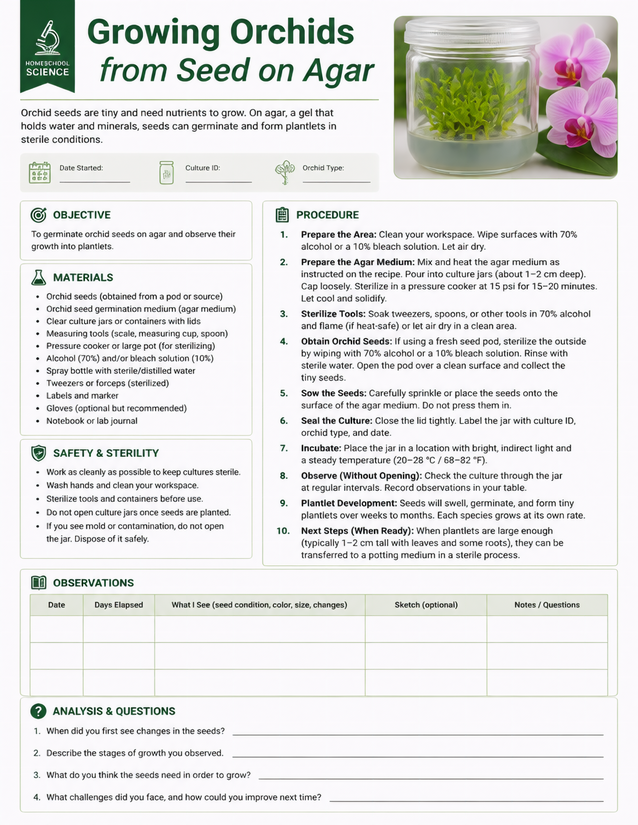
Germinate orchid seeds in sterile culture jars with this growing orchids from seed on agar lab sheet, suited for grades 6-10.
Getting Started with Growing Orchids from Seed on Agar

Usage Notes
Specialty supplies are required here: orchid seed germination medium, clear culture jars with lids, and a pressure cooker for sterilization are all listed on the materials section. Alcohol (70 percent) and a 10 percent bleach solution appear under both materials and safety notes, so review the sterility section with your student before beginning. Gloves are listed as optional but recommended, and the sheet explicitly instructs students never to open culture jars once seeds are sown if mold or contamination appears.

Printing Tips
Slip a single printed copy into a plastic sheet protector inside a lab binder so the procedure stays clean and visible during the sterilization and sowing steps. Use at least 24-pound paper if your student writes directly on the observation table, since multiple entries over weeks can press through thinner stock.