Creative Minds 𖹭 Happy Hearts

Growing Peas and Beans Nitrogen Fixation Lab Sheet
Six to eight weeks of growing peas and beans nitrogen fixation data, recorded pot by pot, gives your student a front-row look at how legumes quietly rebuild soil.
This lab sheet guides grades 5 through 8 students through a controlled comparison of pea and bean plants grown in low-nitrogen soil over six to eight weeks. Students track height in centimeters, leaf count, and plant health on a 1 to 5 scale across four labeled pots, then examine roots for nodules at the end of the experiment. The growing peas and beans nitrogen fixation question asks whether one legume adds more nitrogen than the other, with the conclusion section prompting students to explain their reasoning.
The sheet fits naturally into a soil biology or botany unit study and works as a standalone multi-week investigation. Two nitrogen-testing options are provided, a soil test kit for quantitative data and a simple soil color comparison for families without specialty supplies. By completing the full data table and writing a conclusion, your homeschooler demonstrates understanding of the Rhizobium bacteria partnership, controlled variable design, and evidence-based scientific reasoning.
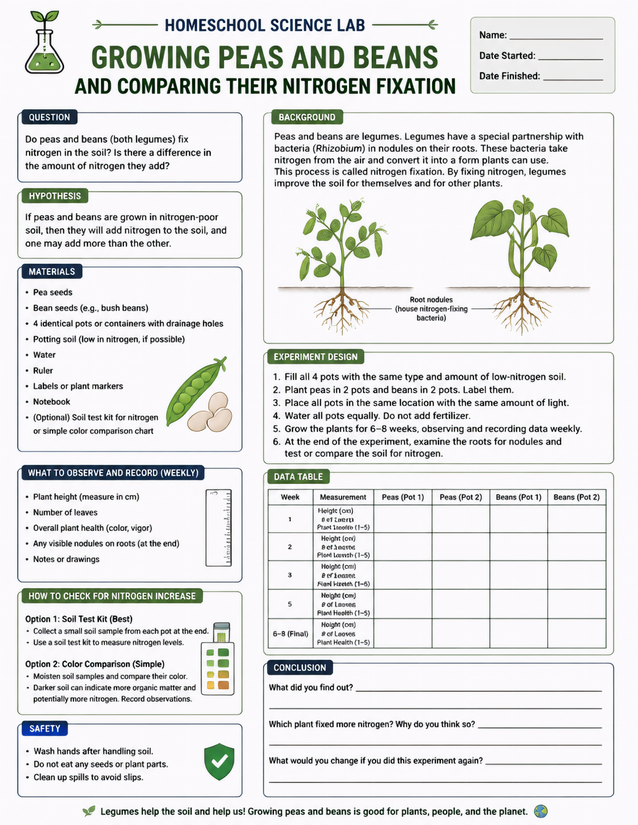
Comparing growing peas and beans nitrogen fixation over six to eight weeks suits grades 5 through 8 homeschool science units on soil biology.
Investigating Growing Peas and Beans Nitrogen Fixation Over Six Weeks

Usage Notes
Most materials on this sheet are household or garden-supply items: pea seeds, bean seeds, four identical pots with drainage, low-nitrogen potting soil, water, a ruler, and labels. The optional soil test kit for nitrogen is a specialty purchase, though the sheet offers a soil color comparison as a workable alternative. Students handle soil throughout, and the safety section specifically notes washing hands after contact, not eating seeds or plant parts, and cleaning up spills.

Printing Tips
A 24-pound or 32-pound paper weight is worth it here since students write weekly measurements directly on the data table over up to eight sessions. Slip the sheet into a plastic page protector inside a lab notebook to protect it from soil and water splashes near the growing area, and keep it loose enough to lay flat on a surface for easy writing.