Creative Minds 𖹭 Happy Hearts

Growing Plants from Cuttings in Water, Homeschool Science Lab
Growing plants from cuttings in water is one of those experiments that actually shows results your student can measure, in root length, day by day.
Your student begins by forming a hypothesis about whether a plant cutting can sprout roots in plain water, then follows a seven-step procedure that covers selecting a healthy stem, cutting just below a node, removing submerged leaves, and placing the cutting in a glass jar. An observation table tracks date, visible changes to leaves and stem, root presence, and approximate root length across multiple sessions. This lab is appropriate for grades 3 through 6 and pairs naturally with a plant biology or life cycles unit study.
The growing plants from cuttings in water experiment works as a standalone activity or as the opening investigation in a broader botany sequence, connecting to lessons on plant propagation, vegetative reproduction, and what plants need to survive. By the time your student fills in the conclusion section and answers what they will try next, they have practiced forming a testable question, recording observations over time, and comparing results to a prediction, all core skills for scientific thinking at this level.
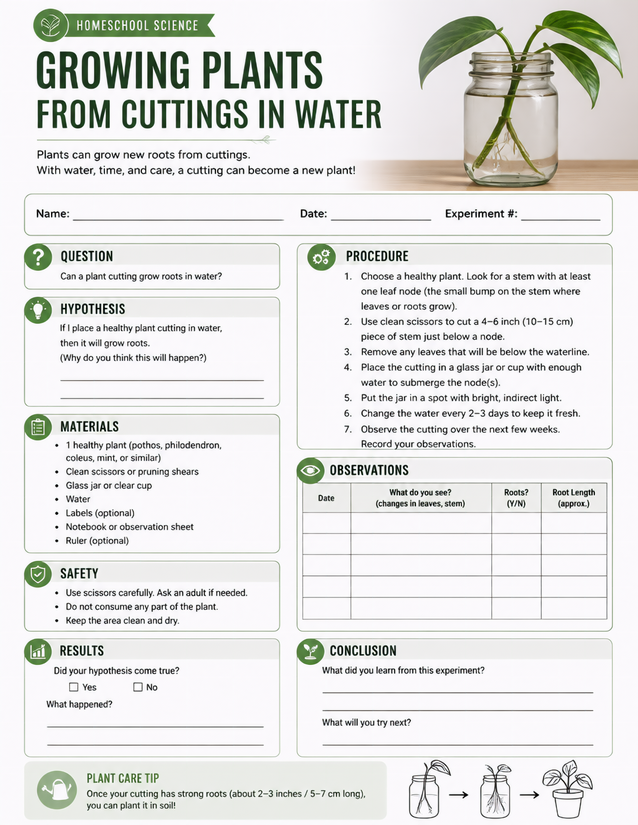
Record root growth week by week with this growing plants from cuttings in water lab sheet, suited for grades 3 through 6.
Recording Results for Growing Plants from Cuttings in Water

Usage Notes
Supplies are almost entirely household items: clean scissors or pruning shears, a glass jar or clear cup, water, and a healthy plant such as pothos, philodendron, coleus, or mint. A ruler is listed as optional for measuring root length. The sheet flags two safety points worth reviewing with younger students: handle scissors carefully and do not consume any part of the plant.

Printing Tips
Twenty-pound copy paper is fine here since students write in the observation table over several sessions at a desk rather than outdoors. Slip the printed sheet into a plastic page protector inside a lab notebook so it stays flat and legible across the two to four weeks the experiment runs.