Creative Minds 𖹭 Happy Hearts

Growing Plants in Different Soil Amendments, Grades 4-7
Sand, clay, silt, potting soil, four pots, one question. Growing plants in different soil amendments gives your student a front-row seat to how soil composition shapes everything a seedling does.
This lab sheet walks your student through a controlled comparison of four soil types: sand, clay, silt, and potting soil used as the control. Students write a hypothesis, follow a nine-step procedure, and measure plant height in centimeters every day for up to 14 days, recording results in a structured data table that also tracks color, leaf size, and other observable differences. The sheet identifies independent, dependent, and controlled variables explicitly, making it a strong fit for grades 4 through 7 who are building foundational experimental design skills.
Growing plants in different soil amendments works well as a standalone unit on plant biology or as part of a broader earth science or agriculture unit study. The 7-to-14-day timeline means your homeschooler lives with the experiment long enough to see real divergence between soil types, and the conclusion prompt pushes them to explain not just what happened but why. Completing the sheet demonstrates understanding of controlled variables, data collection, and evidence-based reasoning.
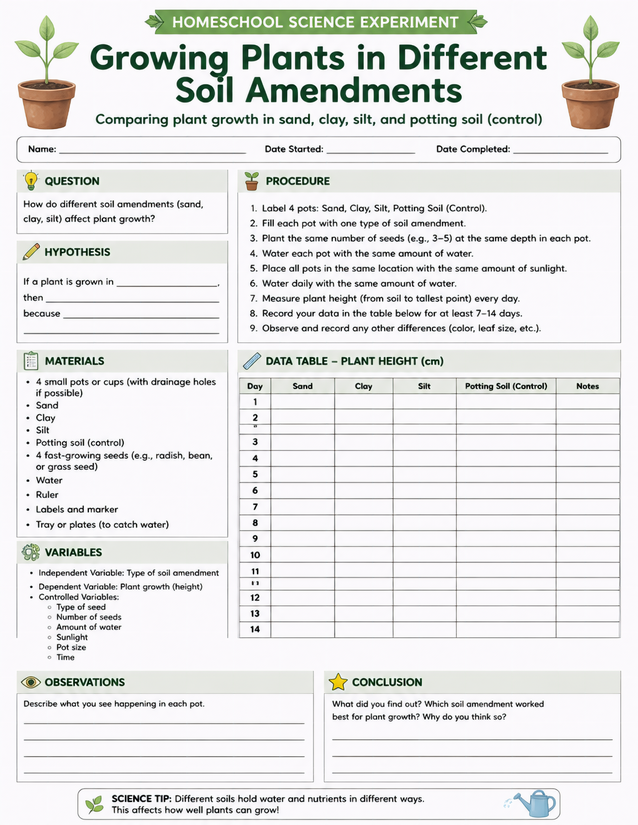
Sand, clay, silt, and potting soil compared side by side: the growing plants in different soil amendments lab sheet for grades 4-7.
Investigating Growing Plants in Different Soil Amendments

Usage Notes
Sand, clay, silt, and potting soil are the four materials your student needs to source before starting. Small pots or cups with drainage holes, fast-growing seeds such as radish or bean, a ruler, and a watering tray round out the list. Sand and potting soil are easy to find at any garden center; clay and silt may require a bit more searching, though craft clay can substitute in a pinch.

Printing Tips
A 24-pound or heavier paper keeps the 14-day data table sturdy enough for daily pencil entries without bleed-through. Slide the sheet into a clipboard so your student can carry it to wherever the pots are living, or three-hole punch it and add it directly to a science lab notebook for the unit.