Creative Minds 𖹭 Happy Hearts

Growing Plants in Sterilized Soil vs Regular Soil Lab Sheet
Microorganisms in soil can help plants or harm them, and growing plants in sterilized soil is exactly how your student finds out which effect wins.
This lab sheet guides students through a controlled plant growth experiment comparing sterilized soil against regular potting soil over a 21-day observation window. Students write a hypothesis, gather household materials, sterilize one soil sample using either an oven or microwave method, then track plant height in centimeters alongside observations on leaf color, leaf count, and overall health at days 3, 7, 10, 14, and 21. It suits grades 4 through 7 and works well within a unit study on ecosystems, soil science, or plant biology.
The growing plants in sterilized soil experiment teaches students to isolate a single variable, record quantitative and qualitative data in the same table, and draw conclusions that connect back to their original hypothesis. The analysis section asks four targeted questions about which plant grew taller, which appeared healthier, and what might explain the differences, giving your homeschooler practice in scientific reasoning rather than just data collection. A conclusion prompt at the bottom asks whether results supported the hypothesis and why, making this a complete standalone lab or a strong anchor for a broader soil or microbiology unit.
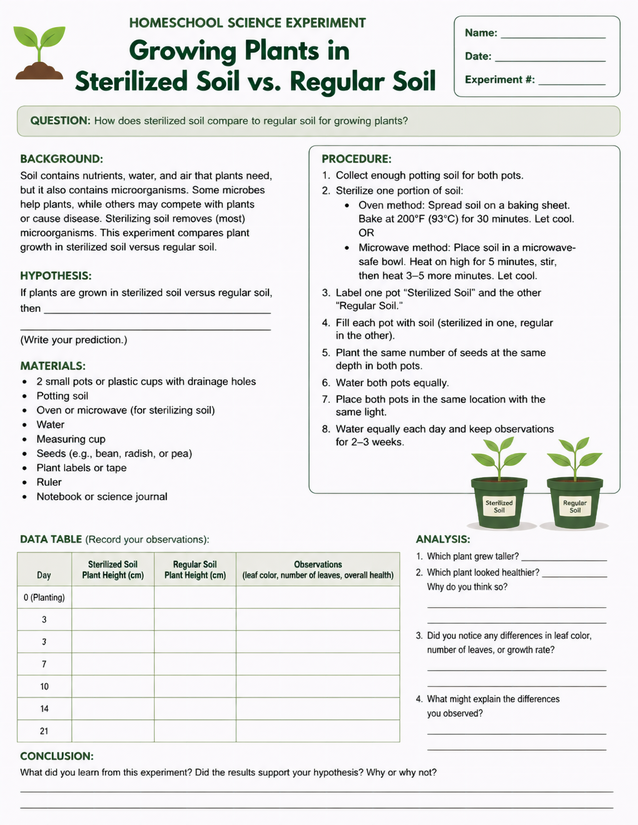
Does sterilized soil help or hurt seedling growth? This growing plants in sterilized soil experiment guides grades 4-7 through a three-week comparison.
Investigating Growing Plants in Sterilized Soil Over 21 Days

Usage Notes
Most materials are already in a homeschool kitchen: potting soil, two small pots or plastic cups, water, a measuring cup, seeds such as beans, radishes, or peas, and a ruler. An oven or microwave is required to sterilize one soil portion, so supervise younger students closely during that step. Seeds and plant labels are the only items you may need to pick up if they are not already on hand.

Printing Tips
Standard 20-pound printer paper works, but 24-pound holds up better when students press firmly while recording daily measurements. Print as a loose sheet to clip onto a clipboard near the growing pots, so your student can log observations without carrying a notebook back and forth each day.