Creative Minds 𖹭 Happy Hearts

Growing Potatoes Using Different Watering Schedules, Lab Sheet
Water daily, every three days, or weekly and let the harvest tell you who wins. Growing potatoes different watering schedules is a real controlled experiment your student can run start to finish.
Growing potatoes different watering schedules puts a single, testable question at the center of an 8 to 12 week experiment: does watering frequency change how many potatoes a plant produces? Your student plants 12 to 15 seed potatoes across three large containers, assigns each container to Schedule A (daily), Schedule B (every three days), or Schedule C (weekly), then tracks plant height, leaf count, leaf health, and signs of wilting week by week in the built-in data table. The sheet is well matched to grades 4 through 7 and walks students through writing a structured hypothesis before they plant a single potato.
This lab fits naturally into a unit study on plant biology, food science, or sustainable gardening, and it works as a standalone long-term project too. Because all other variables, soil type, container size, sunlight, and location, are held constant, your homeschooler is practicing genuine experimental design rather than just observing. At harvest, students count and compare yields across all three groups and write a conclusion that asks them to explain what happened and what they would change next time.
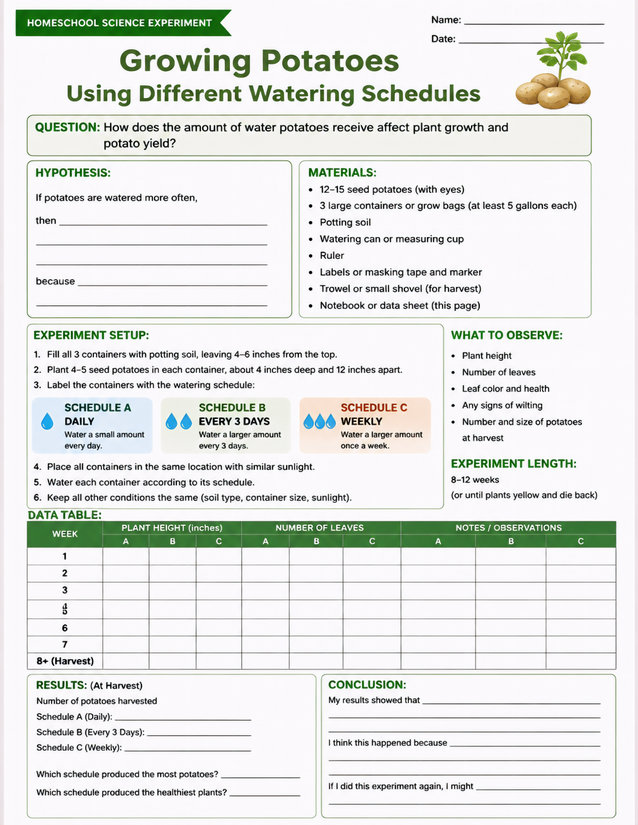
How does watering frequency affect potato yield? This growing potatoes different watering schedules experiment suits grades 4 to 7.
Getting Started with Growing Potatoes Different Watering Schedules

Usage Notes
Materials lean heavily on hardware store and garden center staples. Your student will need 12 to 15 seed potatoes with eyes, three grow bags or large containers of at least 5 gallons each, potting soil, a watering can or measuring cup, a ruler, labels or masking tape, and a trowel for harvest. No specialty science supplies are required, though the experiment does run 8 to 12 weeks, so plan your planting date accordingly.
Printing Tips
A 28-pound paper holds up better than standard copy paper if your student is recording observations outdoors near the containers each week. Punch and insert into a dedicated science lab notebook so all seven weeks of data stay together with the harvest results page.