Creative Minds 𖹭 Happy Hearts

Growing Seeds in Zero-Gravity Simulation, Rotating Platform Lab
Clinorotation on a kitchen turntable, meet plant science. Growing seeds in zero-gravity simulation gives your homeschooler a front-row look at how microgravity disrupts the directional growth cues plants rely on.
Designed for grades 5-8, this lab sheet walks your student through a controlled comparison between seeds grown on a slowly rotating platform and seeds grown in a stationary container. The rotating platform runs at 1-2 RPM to simulate microgravity through clinorotation, and your homeschooler records germination count, shoot length, root length, and growth direction daily for 10 days. Independent, dependent, and controlled variables are all printed on the sheet, making it a strong introduction to experimental design vocabulary.
Growing seeds in zero-gravity simulation fits naturally into a space science unit study or a broader plant biology sequence covering gravitropism and tropisms generally. The experiment runs long enough for meaningful data but requires only a few minutes of daily observation, so it works well inside a structured homeschool week. By the conclusion section, your student is analyzing whether the rotating platform actually reduced gravity’s influence on root and shoot direction, which is exactly the kind of evidence-based reasoning middle school science emphasizes.
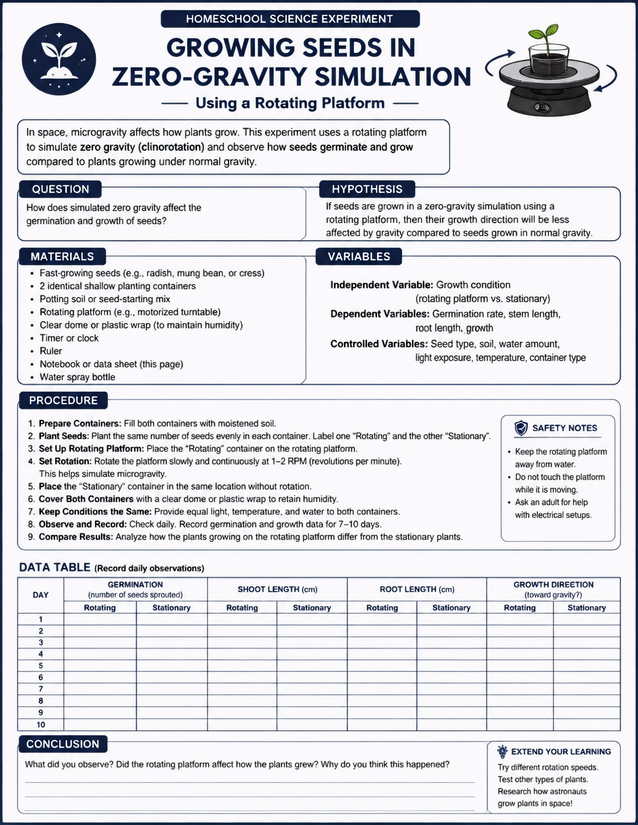
Homeschool grades 5-8 will love this growing seeds in zero-gravity simulation experiment using a rotating platform to mimic microgravity conditions.
Setting Up the Growing Seeds in Zero-Gravity Simulation Experiment

Usage Notes
A motorized turntable is the one specialty item here. Fast-growing seeds such as radish, mung bean, or cress are called out by name on the sheet, and everything else, including potting soil, two identical shallow containers, a clear dome or plastic wrap, a ruler, and a water spray bottle, is a household or garden-center supply. The safety notes on the sheet flag an important caution: keep the rotating platform away from water and do not touch it while it is moving, so review those with your student before setup day.

Printing Tips
A 24-pound paper handles the daily writing load in the 10-row data table better than standard copy weight. Slip the sheet into a plastic page protector inside a lab notebook, or keep it as a loose sheet on a clipboard next to the containers where your student can mark it during daily checks without disturbing the experiment.