Creative Minds 𖹭 Happy Hearts

Growing Watercress and Testing Nitrate Levels in Water
Nitrates, watercress, and three trays of very different water: the growing watercress and testing nitrate levels experiment gives your student a front-row view of how plants clean contaminated water.
Your student will grow watercress in three water samples, tap water as a control, pond water, and water spiked with a small amount of fertilizer, then use a nitrate test kit to measure how much nitrate each sample contained on Day 0 and again on Day 7. The data table captures nitrate level before and after, change in mg/L, and average plant height in centimeters, so your homeschooler is working with real numbers rather than general impressions. The growing watercress and testing nitrate levels experiment suits grades 5-8 and runs over seven days with daily misting.
This sheet fits naturally into a unit study on water quality, environmental science, or plant biology, and it introduces controlled variables in a way that sticks because the student sets them up by hand. Independent and dependent variables are named directly on the sheet, which makes it easier to lead a discussion about experimental design after results are in. Add it to your curriculum alongside a lesson on water pollution or nutrient cycles and your student finishes the week able to explain, with data, why aquatic plants matter.
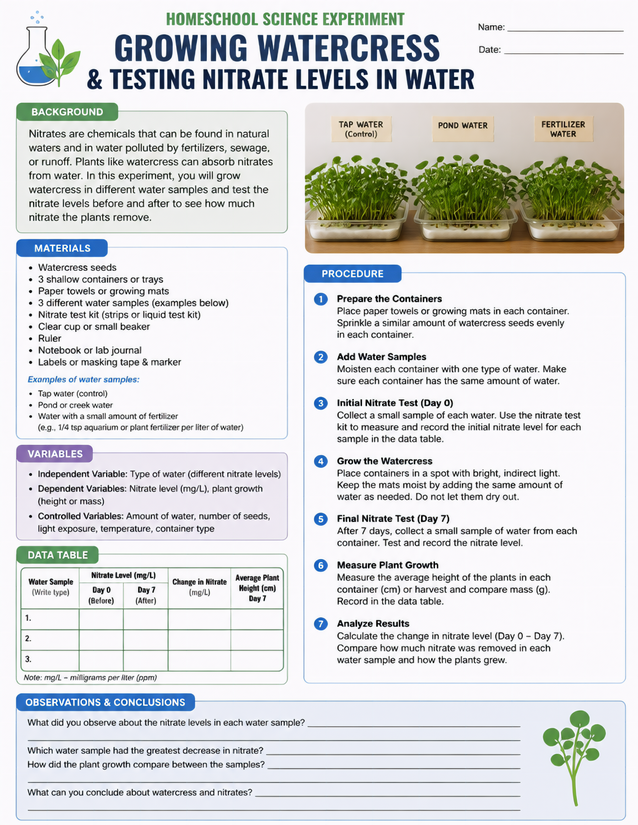
Grades 5-8 homeschool science: the growing watercress and testing nitrate levels experiment runs seven days with three water samples. Download free.
Investigating Growing Watercress and Testing Nitrate Levels Over Seven Days

Usage Notes
Watercress seeds, three shallow trays or containers, paper towels or growing mats, and a nitrate test kit are the core supplies. Seeds and paper towels are easy household-adjacent finds; the nitrate test kit (strips or liquid) is the one specialty item worth ordering ahead. No open flame or chemicals beyond trace fertilizer are involved, though the sheet implies keeping water samples clearly labeled to avoid cross-contamination between trays.

Printing Tips
Slip a copy into a lab notebook before Day 1 so the data table stays with the experiment for the full seven days. Regular 20-pound printer paper works for the written sections, but bumping to 24-pound reduces bleed-through if your student writes with a felt-tip marker on the data table.