Creative Minds 𖹭 Happy Hearts

Growing Watercress on a Damp Paper Towel, Homeschool Lab Sheet
Seeds, a paper towel, and a sunny windowsill are all it takes. Growing watercress on a damp paper towel gives your student a front-row seat to germination without pots, soil, or any special setup.
This lab sheet walks your student through the full scientific process of growing watercress on a damp paper towel over seven to ten days. The sheet opens with a research question and a fill-in hypothesis, then moves through eight numbered procedure steps covering how to wet the towel, sprinkle seeds, mist, and optionally cover with plastic wrap to retain moisture. A ten-row daily observation table with columns for what the student sees and any changes or notes keeps the record-keeping structured and simple. This experiment is well matched to grades 2-5 homeschool science and works as a standalone introduction to plant biology or as an early unit study lesson before moving on to more controlled variable experiments.
As a germination study, it gives your homeschooler direct evidence of what seeds need: moisture, warmth, and light. Three reflection questions at the bottom ask what happened to the seeds, what conditions they needed, and what the student learned, prompting written synthesis rather than just passive observation. The sheet includes a draw-your-setup box so students sketch their tray arrangement before the experiment begins, adding a hands-on planning step that reinforces the scientific method from start to finish.
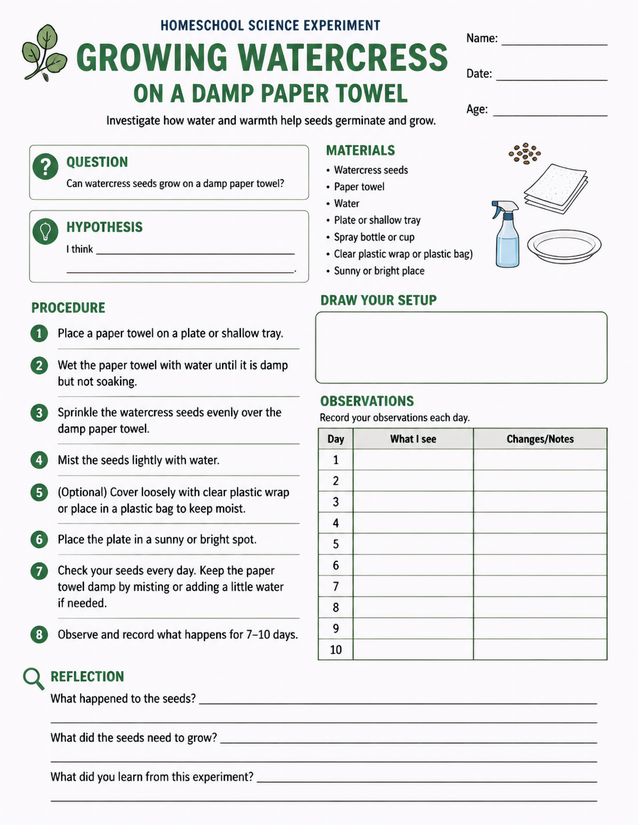
Watch germination happen day by day with this growing watercress on a damp paper towel lab sheet, suited for grades 2-5.
Exploring Growing Watercress on a Damp Paper Towel

Usage Notes
Every material on this sheet is a household item: a paper towel, a plate or shallow tray, water, a spray bottle or cup, and optional clear plastic wrap or a plastic bag. Watercress seeds are the one specialty supply, available inexpensively at garden centers or online. No heat sources or chemicals are involved, so no safety precautions are needed beyond keeping the tray in a stable spot where it will not be disturbed.

Printing Tips
Standard 20-pound copy paper works fine here since students fill in the table daily at a desk rather than handling the sheet outdoors. Punch and slip it into a science lab notebook at the start of the experiment so all ten days of observations stay together in one place.