Creative Minds 𖹭 Happy Hearts

Heat Retention of Different Colored Containers Lab Sheet
Four cups, four colors, one question: does container color actually change how long hot water stays warm? This heat retention of different colored containers lab gives your student real interval data to answer it.
Your student tests whether container color influences how quickly hot water cools by recording temperature readings at 10-minute intervals across 60 minutes. The sheet walks through hypothesis writing, variable identification (independent, dependent, and controlled), a seven-step procedure, and a structured data table for white, black, red, and blue containers. Designed for grades 4-7, this heat retention of different colored containers lab sheet builds both measurement skills and scientific reasoning in a single session.
It fits naturally into a unit study on thermodynamics, light absorption, or properties of matter, and works as a standalone experiment without any prior lab sequence. Completing the analysis questions asks your homeschooler to compare which color retained heat longest and which cooled fastest, then draw a conclusion supported by their own recorded data rather than a textbook answer.
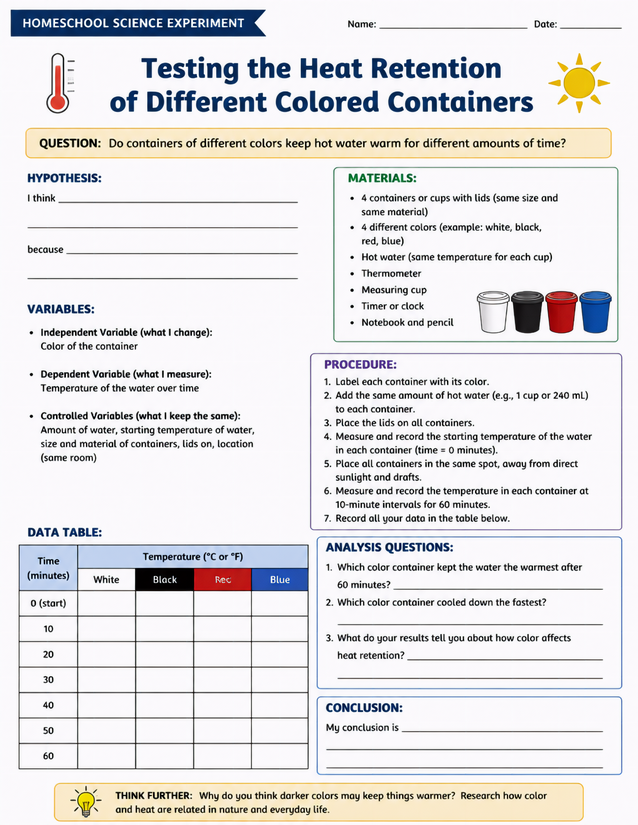
Grades 4-7 homeschoolers test heat retention of different colored containers using hot water, a thermometer, and 60 minutes of interval recording.
Investigating Heat Retention of Different Colored Containers

Usage Notes
Everything on the materials list is a standard household item: four same-size cups with lids in white, black, red, and blue, hot water, a thermometer, a measuring cup, and a timer. No specialty supplies are needed, which makes setup easy to pull together on short notice. Hot water is the only safety consideration here, so supervise your younger homeschooler when filling and lidding the containers.

Printing Tips
Laser or inkjet on 24-lb paper keeps the data table writable without bleeding through, and the seven data rows give enough space for legible numbers. Slip the sheet into a plastic page protector inside a lab notebook so it stays flat while your student returns every 10 minutes to record a new reading.