Creative Minds 𖹭 Happy Hearts

Homophones Mixed Practice Worksheet, Four Activity Types
Four different activity formats, one homophones mixed practice worksheet. Students circle, fill in blanks, choose from a bank, and match pairs, so no two exercises feel the same.
A friendly owl with glasses and a pencil sits atop a stack of books in the top corner, setting an encouraging classroom tone. The layout divides the page into four clearly labeled sections, each tackling homophones through a different task format.
Section one asks students to circle the correct word in sentences featuring pairs like brake/break and bee/be. Sections two and three work with word banks, including the tricky they’re/their/there trio and the less obvious meet/meat/mete set. Section four pairs related sentences so students apply bare/bear, pair/pare, and hole/whole in context, which is where the homophones mixed practice worksheet earns its name. Complexity is moderate, making it a solid independent practice page rather than an introduction.
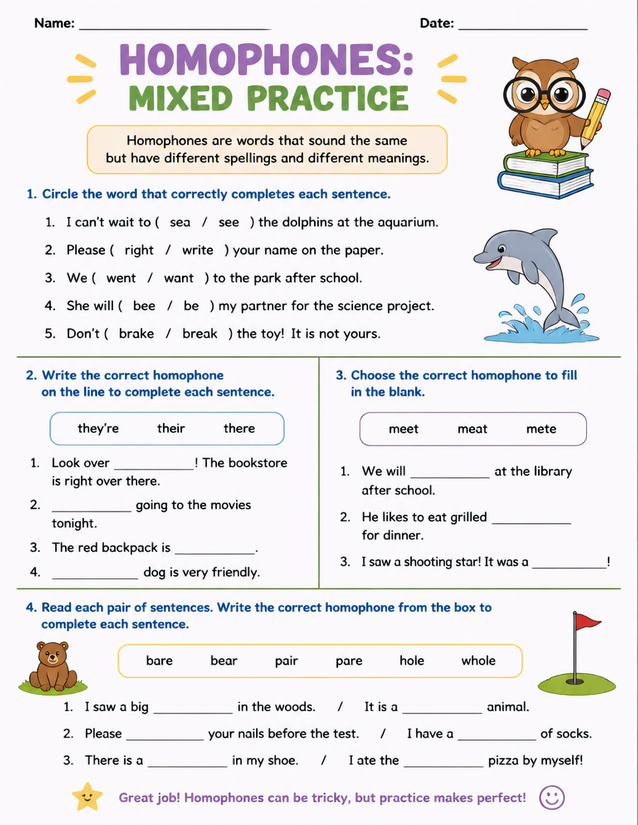
Four activity types in one homophones mixed practice worksheet covering sea/see, their/there/they’re, and more. Instant download.
Where to Begin with the Homophones Mixed Practice Worksheet

Usage Notes
Watercolor pencils are unnecessary here since there is nothing to color, but a set of two or three colored pencils works nicely for coding each section a different color as students work through it. Fine liners in black or dark blue keep written answers legible inside the blank lines, which are narrow. Use gel pens cautiously on lightweight paper, as the tips can drag and smear across the fill-in lines.

Printing Tips
Lightweight 20 lb copy paper is fine for a single-use classroom handout, but bumping to 24 lb prevents ink bleed-through when students write answers in pen. Print at 100 percent scale so the blank lines stay the intended length.