Creative Minds 𖹭 Happy Hearts

Testing Which Household Cleaners Kill Bacteria, Petri Dish Lab
Bleach versus dish soap versus rubbing alcohol on a petri dish: the household cleaners kill bacteria lab makes that question answerable with a cotton swab and 48 hours.
Your student swabs a real household surface, such as a doorknob, kitchen counter, or faucet handle, transfers that bacteria to nutrient agar in a petri dish, and then applies 4 to 5 different cleaners to separate dishes to see which one reduces bacterial colony growth most effectively. The household cleaners kill bacteria lab walks grades 5-7 through a full scientific process: writing a hypothesis, controlling variables with a no-cleaner control dish, recording colony counts after 24 to 48 hours of incubation, and rating each cleaner’s performance on a Best to Poor scale.
This lab fits naturally into a microbiology or household chemistry unit study and works as a standalone experiment that takes two sessions to complete, one for setup and one for observation. A student who finishes the sheet has practiced reading a results table, written comparative analysis across four prompted questions, and answered a think-further question about reducing germ spread at home, demonstrating both lab technique and scientific reasoning.
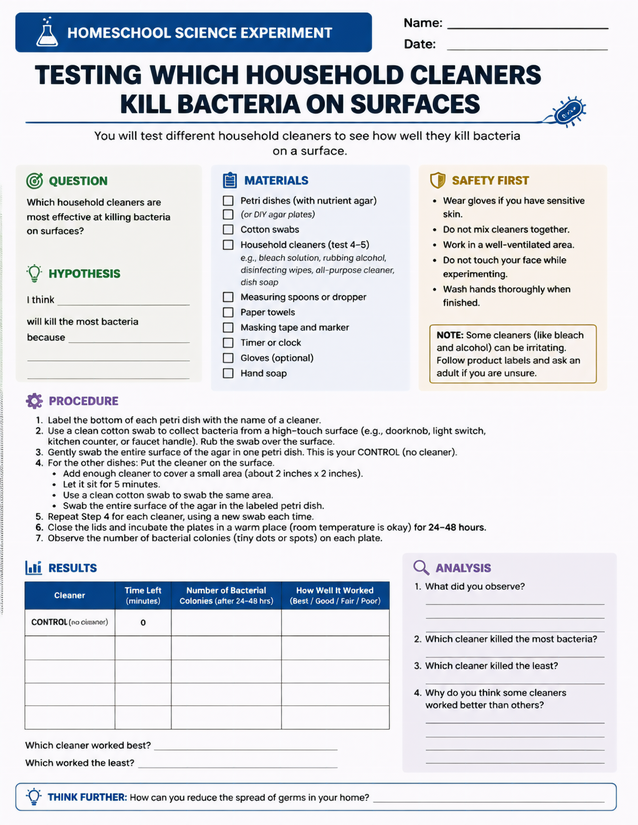
Bleach, rubbing alcohol, dish soap: this household cleaners kill bacteria lab guides grades 5-7 through real petri dish results.
Getting Started with the Household Cleaners Kill Bacteria Lab

Usage Notes
Most materials here are already in your home: cotton swabs, paper towels, masking tape, a marker, and the cleaners themselves such as bleach solution, rubbing alcohol, disinfecting wipes, all-purpose cleaner, and dish soap. The specialty item is petri dishes with nutrient agar, though the sheet notes DIY agar plates as an option. The safety section on the sheet is thorough and worth reviewing with your student before starting, since bleach and alcohol require gloves, good ventilation, and a no-mixing rule.
Printing Tips
Standard 20 lb printer paper works for this sheet since students fill it in at a desk before and after the experiment, not during hands-on work at the bench. Slip it into a plastic page protector in a lab notebook to keep it clean if the experiment is running nearby.