Creative Minds 𖹭 Happy Hearts

Household Substances Cause the Most Corrosion Lab Sheet
Eight clean nails, eight cups, and one big question: household substances cause the most corrosion on metal, but which one wins? Your student is about to find out.
Your student tests eight common liquids, water as the control plus options like vinegar, bleach, ammonia, salt water, lemon juice, baking soda solution, and cola, against steel nails or paper clips to observe which household substances cause the most corrosion over 24 to 48 hours. The sheet guides grades 4-7 through a full scientific sequence: forming a hypothesis, following a nine-step procedure, and rating each result on a 0-to-5 corrosion scale with space to sketch observations. Five structured analysis questions close the lab, asking your student to compare substances, explain why some corrode faster, and connect the findings to real-world applications.
This sheet works well as a standalone chemistry introduction or within a broader unit study on chemical reactions, metals, or environmental science. A built-in corrosion explainer defines rust as a chemical reaction between metal and its environment, giving your homeschooler the vocabulary before they begin recording data. By the end, your student has moved from prediction to evidence-based conclusion using a format that mirrors real lab practice.
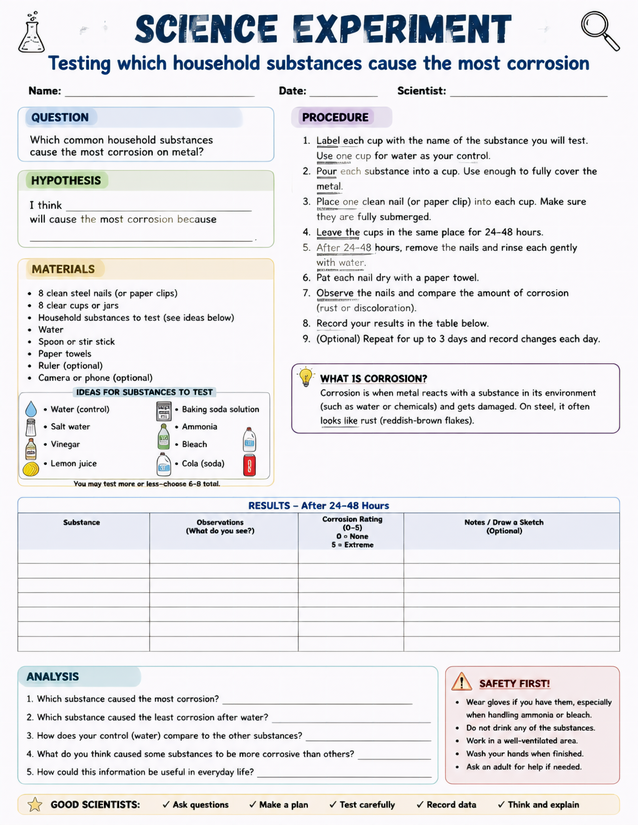
Which household substances cause the most corrosion? This grades 4-7 homeschool lab sheet walks your student through a 24-48 hour metal corrosion experiment.
Investigating Household Substances Cause the Most Corrosion

Usage Notes
Nearly everything on the materials list is already in your kitchen or utility closet. Steel nails or paper clips, clear cups, water, vinegar, lemon juice, salt, baking soda, cola, bleach, and ammonia cover the full test range. Bleach and ammonia are the two safety flags on the sheet itself: the printed safety panel reminds students to wear gloves, work in a ventilated area, and ask an adult for help when handling those two substances.
Printing Tips
Standard printer paper handles pencil and pen entries well for a 24-48 hour observation window, but 32 lb paper holds up better if cups are nearby and the sheet risks moisture. Slip it into a plastic page protector inside a lab notebook so your student can flip back to the hypothesis while checking cup progress without the sheet leaving the binder.