Creative Minds 𖹭 Happy Hearts

Hydroelectric Power Plant Model Lab Sheet, Turbine to LED
Water flows downhill, spins a plastic turbine, and lights an LED. Your student records every step on this hydroelectric power plant model lab sheet built around that chain of cause and effect.
Grounded in potential and kinetic energy, this hydroelectric power plant model lab sheet walks grades 4-8 homeschoolers through building a reservoir, attaching a penstock tube, mounting a small turbine, and wiring a DC motor to an LED. The goal printed on the sheet is explicit: use moving water to spin the turbine and light the LED. Observations prompt your student to note what happened when the water started flowing, what affected LED brightness, and what changes improved the model.
The sheet fits naturally into an energy conversion unit study or a broader electricity and circuits sequence. It works as a standalone hands-on lesson or as a follow-on after simpler circuit work. By completing it, your homeschooler demonstrates understanding of gravitational potential energy, energy transfer, and basic circuit connections, and has a written record of their observations and conclusion to add to their science portfolio.
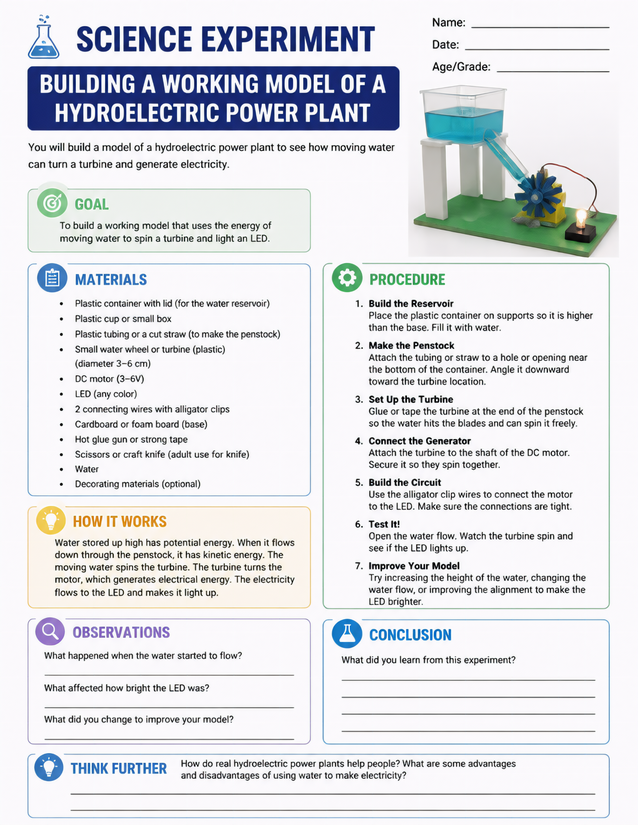
Build a hydroelectric power plant model lab sheet designed for grades 4-8. Moving water spins a turbine and lights an LED.
Getting Started with Your Hydroelectric Power Plant Model Lab Sheet

Usage Notes
Most materials are household or low-cost hardware items: a plastic container with a lid for the reservoir, plastic tubing or a cut straw for the penstock, and cardboard or foam board for the base. Specialty items are a small plastic turbine or water wheel (3-6 cm diameter), a DC motor rated 3-6V, an LED, and two alligator clip wires. The sheet flags scissors or a craft knife as adult-use tools, so plan to handle cutting steps yourself.
Printing Tips
Cardstock at 65-pound weight holds up better than copy paper when the sheet sits near a water reservoir during testing. Punch and insert it into a science lab notebook after the experiment, or keep it as a loose record sheet in your homeschool portfolio binder.