Creative Minds 𖹭 Happy Hearts

Identifying Fractions Worksheet, Shaded Shapes and Written Descriptions
Shaded circles, divided rectangles, and written clues all on one page: this identifying fractions worksheet gives your student three distinct ways to practice reading fractions before moving on.
Suited for grades 2 and 3, this identifying fractions worksheet moves through three numbered sections. Section one shows four shapes, including quartered circles and divided rectangles, and asks students to write the fraction represented by the shaded portion. Section two repeats the format with new shapes divided into more parts, such as eighths and thirds. Section three shifts to written descriptions, asking students to convert phrases like ‘five out of eight parts are shaded’ directly into fraction notation.
The three-part structure makes this identifying fractions worksheet a natural fit for a short math block or as seat work alongside a fractions unit study. Your student can work through it independently once you have introduced numerator and denominator vocabulary, or you can walk through section one together before releasing them to finish sections two and three on their own. The sheet builds two connected skills: reading visual models and translating word descriptions, which reinforces that a fraction is always a relationship between parts and a whole.
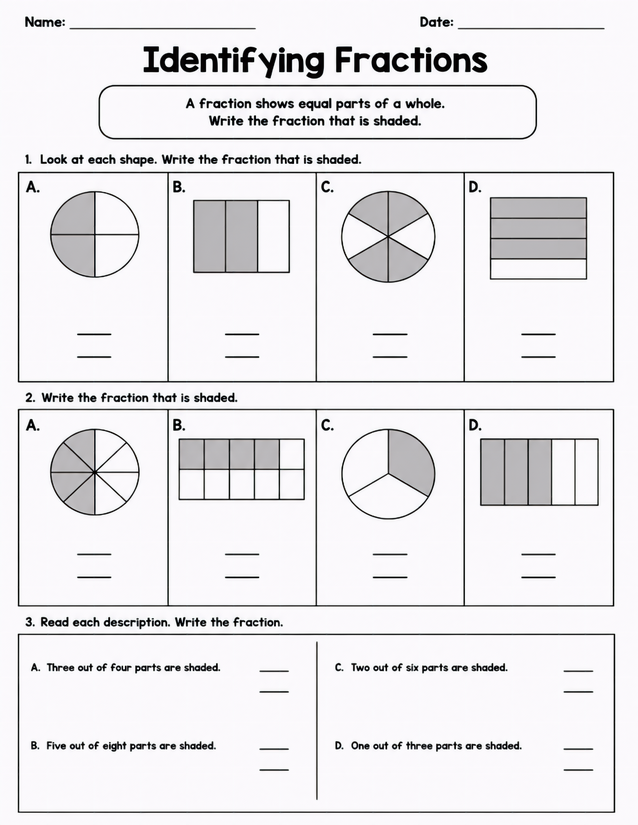
Shaded circles and rectangles make this identifying fractions worksheet clear and approachable for grades 2 and 3 homeschoolers. Instant download.
Practicing with an Identifying Fractions Worksheet in Three Formats

Usage Notes
A pencil works best here since students write fraction notation in small spaces and may want to revise their answers. The three sections progress in complexity, so it suits independent practice for a student who has had one introductory lesson, or guided instruction for a student seeing fractions for the first time.
Printing Tips
Standard copy paper is fine for writing. Portrait orientation is fixed by the layout, so print as-is. Running a few copies lets your student revisit the visual sections on separate days without reusing a marked sheet.