Creative Minds 𖹭 Happy Hearts

Insulation Properties of Ice Cream Lab, Four Materials Tested
Four cups, four insulators, one melting clock. Recording the insulation properties of ice cream forces your student to confront heat transfer in the most delicious way possible.
Your student wraps four identical cups of ice cream in aluminum foil, bubble wrap, a towel or cloth, and cardboard, then records temperatures at 15-minute intervals for up to two hours. The sheet provides a structured data table tracking degrees in Fahrenheit or Celsius, with a clear instruction to write MELTED when a cup crosses that threshold. A hypothesis prompt asks students to predict the winner before the experiment begins. Suited for grades 4-6, this lab makes heat transfer tangible without requiring any equipment beyond what most households already own.
The insulation properties of ice cream experiment fits naturally into a unit study on thermal energy, states of matter, or everyday physics. It works as a standalone afternoon lab or as the hands-on anchor for a week of lessons on conductors and insulators. By completing the analysis section, your homeschooler must draw conclusions from their own recorded data and connect results to a real-world application, which insulator would they choose for a picnic? That final question is where the science becomes genuinely theirs.
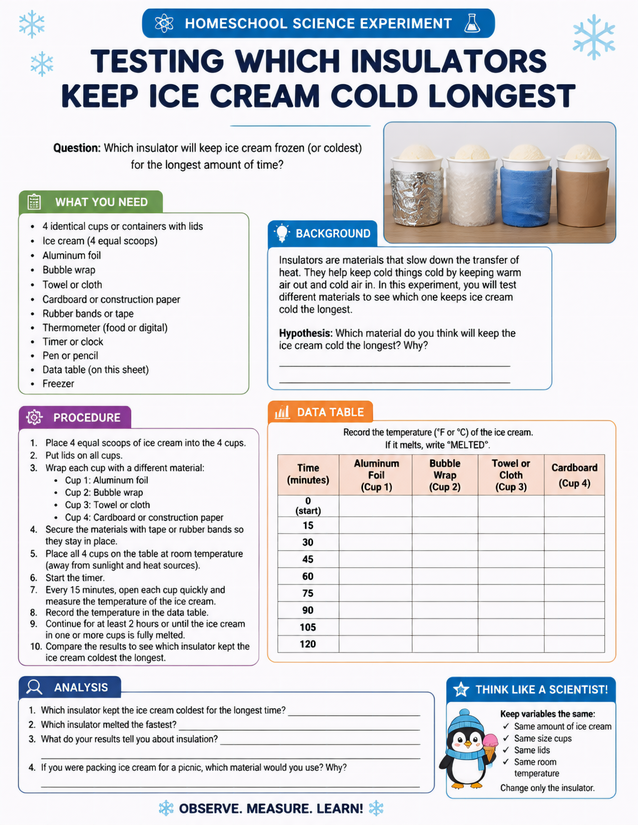
Four cups, four materials: this insulation properties of ice cream experiment logs temperature every 15 minutes for grades 4-6 homeschoolers.
Investigating Insulation Properties of Ice Cream Across Four Materials

Usage Notes
Everything on the materials list is a household item: four cups with lids, aluminum foil, bubble wrap, a towel or cloth, cardboard or construction paper, rubber bands or tape, and a thermometer. No specialty supplies are needed, though a food or digital thermometer is required and worth checking you have on hand before starting. Because students open each cup briefly every 15 minutes, remind them to work quickly to avoid introducing extra heat into the samples.

Printing Tips
A single loose sheet on a clipboard works well here since students carry it around the room while checking cups. Twenty-four pound paper or heavier holds up better than standard copy paper if the sheet gets set on a damp surface near the ice cream cups.