Creative Minds 𖹭 Happy Hearts

Light Colors on Seed Germination Lab Sheet, 7-Day Observation
Red, blue, green, white, and dark: testing light colors on seed germination gives your student a real variable to argue about at the end of day seven.
Structured around a single, testable question, this lab sheet guides students through a seven-day experiment comparing how five light conditions affect the number of seeds that germinate. Your student states a hypothesis, tracks germination counts daily in a labeled data table, and then answers four analysis questions that ask them to identify which color produced the most and least germination and explain what the data shows. Designed for grades 4-7, the sheet explicitly identifies the independent variable (color of light), the dependent variable (number of seeds germinated), and the controlled variables, making it a strong fit for introducing experimental design in your homeschool science curriculum.
The light colors on seed germination experiment works well as a standalone unit or as an anchor lab within a broader botany or plant biology unit study. Because the experiment runs across seven consecutive days, your student practices consistency and daily observation habits alongside the science content. Completing the data table and written analysis demonstrates that your homeschooler can control variables, record quantitative results, and draw evidence-based conclusions from their own data.
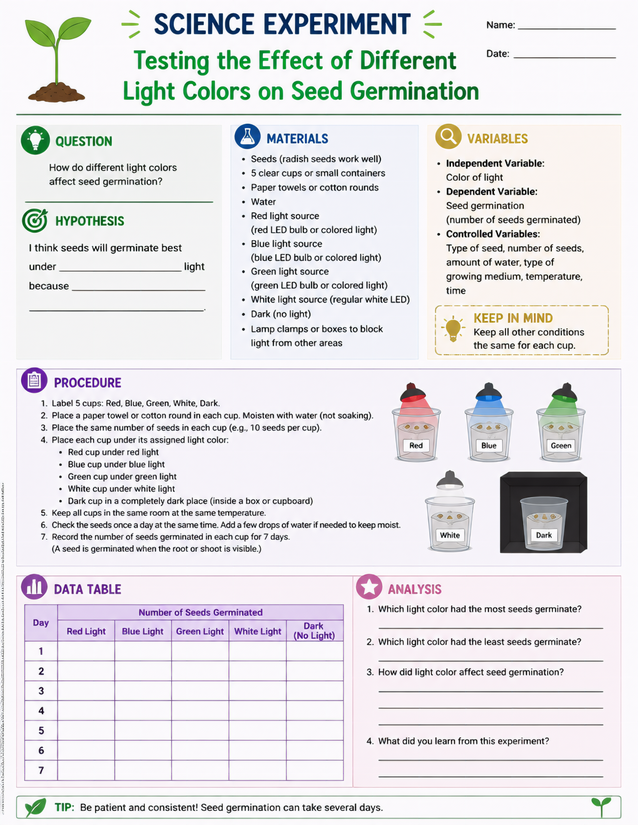
Grades 4-7 homeschoolers compare how light colors on seed germination affect sprout counts across five cups over seven days.
Investigating Light Colors on Seed Germination Over Seven Days

Usage Notes
Radish seeds are listed as the recommended choice, and the sheet calls for five clear cups or small containers, paper towels or cotton rounds, water, and three colored light sources (red, blue, and green LED bulbs or colored lights), plus a regular white LED and a dark enclosure such as a box or cupboard. Nearly all of these are household or easily sourced items, though the colored bulbs may require a quick order. Lamp clamps or boxes to block light from adjacent cups are also listed, so plan your setup space before starting.

Printing Tips
Standard 20 lb copy paper is fine for the data table since students are recording counts rather than doing wet work at the sheet itself. Slip the printed sheet into a plastic page protector or tape it beside the experiment station so it stays legible through seven days of daily check-ins without picking up moisture from the cups.