Creative Minds 𖹭 Happy Hearts

Light on Plant Growth Lab Sheet, Three Light Conditions
Full light, dim light, no light at all. Your student’s light on plant growth lab sheet turns three identical pots into a side-by-side comparison that makes photosynthesis tangible.
Plants in full light, low light, and complete darkness grow differently enough that your student can measure and see the difference over one to two weeks. This light on plant growth lab sheet guides grades 3-6 students through a controlled setup where every variable except light is held constant, then asks them to record height in centimeters and note color, leaf size, and stem strength every two to three days across all three pots.
The sheet works cleanly as a standalone unit on plant biology or as an anchor experiment inside a broader photosynthesis or life science unit study. Four guided questions push your student past raw data toward interpretation, asking them to compare pots and explain what the results reveal about light’s role in plant health. The written conclusion section asks for two to three summarizing sentences, giving your homeschooler practice turning observational data into a scientific claim.
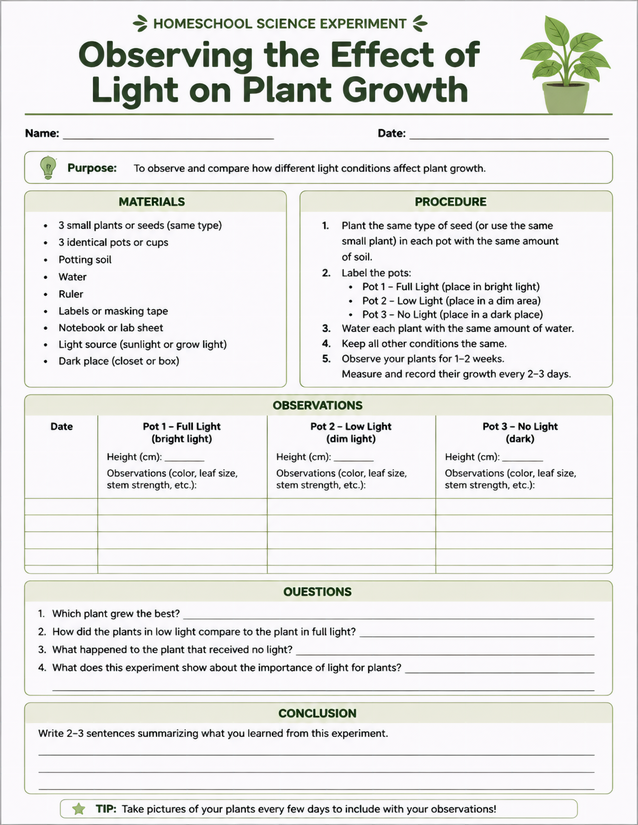
Three pots, three light conditions, one clear outcome. This light on plant growth lab sheet suits grades 3-6 homeschoolers beautifully.
Setting Up Your Light on Plant Growth Lab Sheet

Usage Notes
Everything on the materials list is a household item: small plants or seeds, identical pots or cups, potting soil, water, a ruler, labels or masking tape, and a dark spot like a closet or covered box. No specialty supplies are needed, which makes this one of the lower-barrier experiments in a life science sequence. The only safety note implied by the sheet is keeping the dark-condition pot genuinely light-free between observations.

Printing Tips
Standard 20 lb copy paper holds up fine for daily pencil entries, but 24 lb paper keeps the observation rows crisper if your student writes firmly. Slip the sheet into a lab notebook alongside photos of each pot, or keep it loose on a clipboard near the plants so measuring and recording happen in one step.