Creative Minds 𖹭 Happy Hearts

Making a Cloud Chamber to Detect Cosmic Rays
Radiation from outer space is passing through your living room right now, and making a cloud chamber to detect cosmic rays lets your student actually see those particle tracks with their own eyes.
Making a cloud chamber to detect cosmic rays is the kind of experiment that stops a homeschool lesson cold in the best possible way. This sheet walks grades 6-9 students through an 11-step procedure: lining a clear plastic container with black foam board, soaking felt in isopropyl alcohol, placing dry ice beneath the container, and then waiting for supersaturated vapor to form so that charged particles leave faint visible trails. Students record the date, time, location, and temperature, sketch what they observed, and answer questions about the physics happening inside the chamber.
The sheet fits naturally into a unit study on particle physics, radiation, or space science, and it also works as a standalone investigation that connects abstract concepts to something genuinely visible. By completing it, your homeschooler demonstrates understanding of how ionizing radiation interacts with matter, practices careful observational science, and gets direct evidence that cosmic rays are real and constant. The included “What’s Happening?” explanation supports independent reading for students who are ready to process the physics on their own.
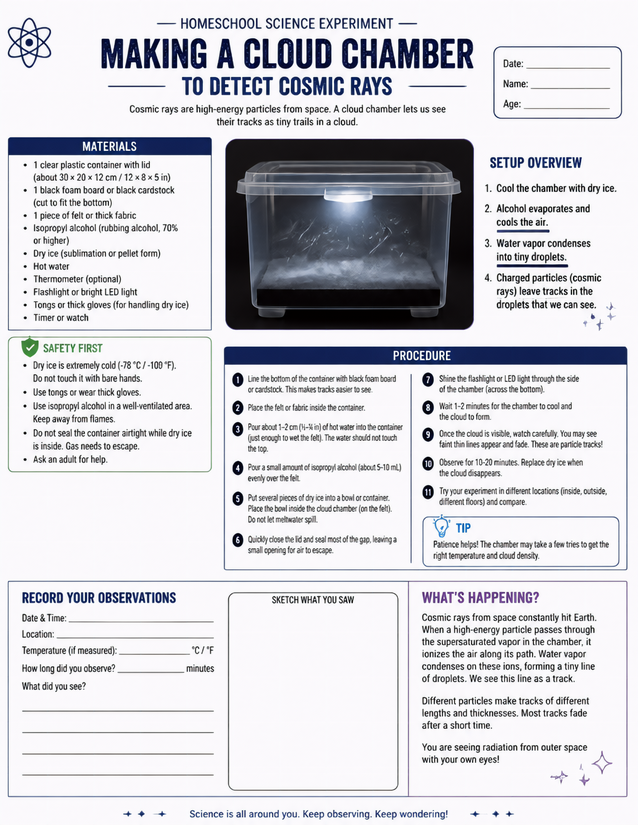
Grades 6-9 homeschool science: making a cloud chamber to detect cosmic rays uses dry ice, isopropyl alcohol, and careful observation. Download free.
Investigating Making a Cloud Chamber to Detect Cosmic Rays

Usage Notes
Dry ice is the one specialty supply here; everything else, including a clear plastic container with a lid, isopropyl alcohol at 70% or higher, black foam board or cardstock, and a flashlight, is a household or hardware-store item. The sheet includes a dedicated Safety First section covering glove use, ventilation for the alcohol, and keeping the container unsealed while dry ice is inside. Handle dry ice with tongs or thick gloves only, and run this experiment in a well-ventilated space.

Printing Tips
Standard 20-pound printer paper works for the observation record, but 24-pound or cardstock holds up better if the sheet gets handled repeatedly during a 10-to-20-minute observation window. Keep it loose on a clipboard so your student can write while watching the chamber, rather than hunching over a bound notebook.