Creative Minds 𖹭 Happy Hearts

Making a Cloud in a Jar, Hairspray and Ice Experiment
Hairspray and ice cubes are all it takes: making a cloud in a jar turns a kitchen counter into a working weather lab in under a minute.
Making a cloud in a jar is the anchor experiment here, and the sheet walks your student through the science behind it before a single supply is gathered. The concept panel explains how hairspray adds condensation nuclei to the air while ice chills the jar from above, causing water vapor to form visible droplets. Designed for grades 3-6, the five-step procedure is written clearly enough for your homeschooler to follow independently, and three guided observation questions ask what they saw, how long cloud formation took, and what they predict would happen if warm water replaced the ice.
This lab works well as a standalone lesson on weather and the water cycle, and it fits naturally into a unit study on atmospheric science or states of matter. The “Think Like a Scientist” prompt at the bottom pushes students to propose a variable change on their own, which is a genuine introduction to experimental design. Completing the observation section gives your student a record of real data collected, not just a craft activity checked off the list.
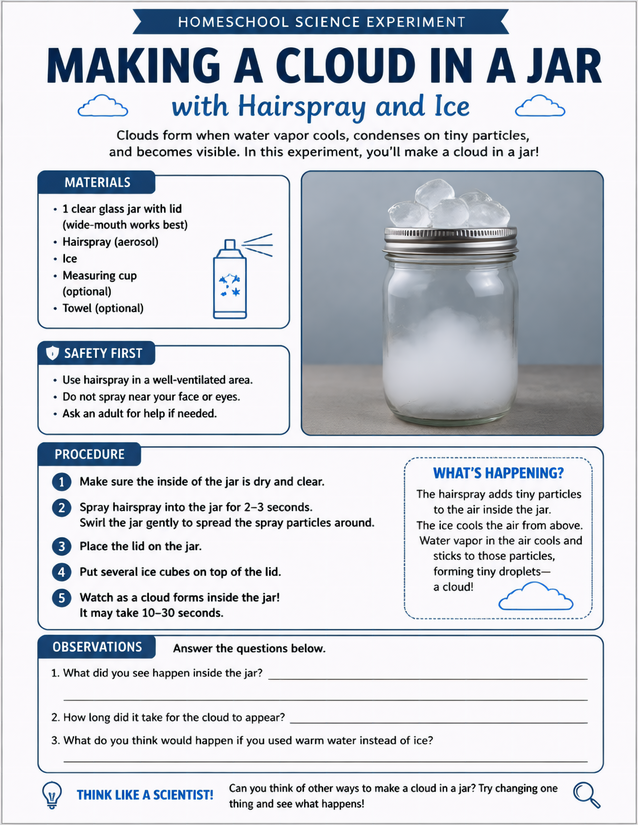
Grades 3-6 homeschool science: making a cloud in a jar teaches condensation using hairspray and ice. All steps and observations included.
Getting Started with Making a Cloud in a Jar

Usage Notes
Household supplies cover everything on the materials list: a wide-mouth glass jar with a lid, aerosol hairspray, and ice are all that is needed. A measuring cup and towel are listed as optional. The safety section on the sheet specifically flags using hairspray in a well-ventilated area and keeping spray away from the face, so plan to run this one near an open window or outside.

Printing Tips
Standard 20-pound printer paper works fine for a single-session lab. Clip it to a board so your student can write observations while watching the jar, since cloud formation happens in 10 to 30 seconds and you do not want them hunting for a hard surface mid-experiment.