Creative Minds 𖹭 Happy Hearts

Making a Lemon Battery to Power an LED
Zinc nails, copper nails, and a few lemons are all it takes. Making a lemon battery that actually lights an LED is one of those experiments your student will want to repeat the moment it works.
Making a lemon battery teaches electrochemistry in a way that produces a visible, satisfying result. The sheet walks students through rolling each lemon to release juice, inserting one zinc nail and one copper nail per lemon, and connecting the cells in series with alligator clip wires until the LED lights. Observation prompts ask whether the LED lit up, how bright it appeared, how many lemons were used, and what changed when more lemons were added. A conclusion section asks students to articulate what they learned. This lab is well matched to grades 4 through 7, especially within an electricity or chemistry unit study.
The sheet includes a clear diagram showing three lemons wired in series with labeled zinc and copper electrodes, which helps your student troubleshoot polarity before touching the LED legs. A How It Works panel explains that lemon juice acts as an electrolyte and that zinc and copper create a flow of electrons through the wire, giving your homeschooler the conceptual grounding to connect the hands-on result to the underlying science. Completed alongside a broader unit on circuits or chemical reactions, this lab demonstrates voltage addition across cells and gives students practice recording quantitative observations.
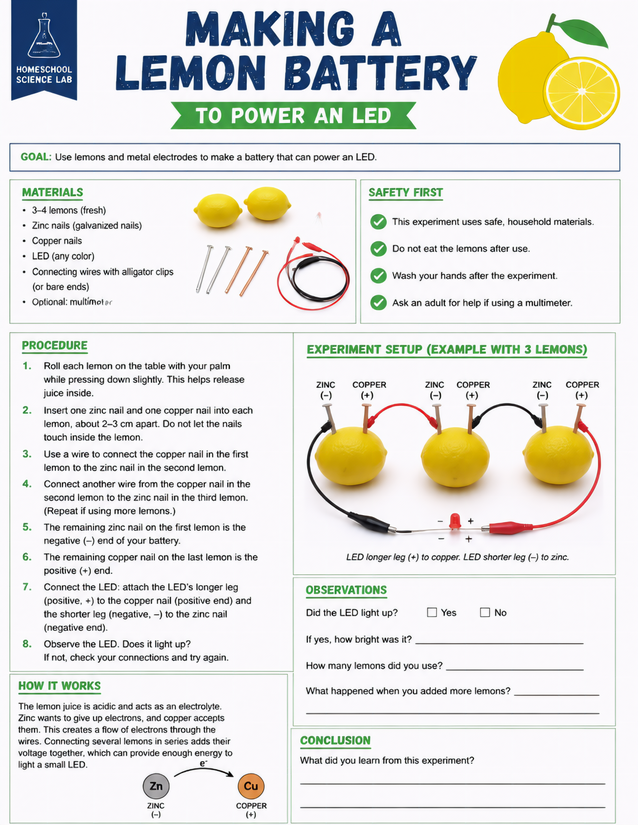
Grades 4-7 homeschool science: making a lemon battery with zinc nails, copper nails, and alligator clip wires lights a real LED.
Getting Started with Making a Lemon Battery

Usage Notes
Fresh lemons, galvanized zinc nails, copper nails, an LED, and connecting wires with alligator clips are all household or easily sourced hardware store items. A multimeter is listed as optional for measuring voltage across the cells. The safety panel notes students should not eat the lemons after use and should ask an adult for help if using a multimeter.

Printing Tips
20 lb copy paper handles the pencil writing in the observations and conclusion sections without trouble. Inserting the completed sheet into a dedicated science lab notebook keeps the electrode diagrams and recorded results together for review later. Laminating is not recommended here since students need to write directly in the observation blanks during the experiment.