Creative Minds 𖹭 Happy Hearts

Making a Model Cell with Gelatin and Candies, Homeschool Lab
Fruit Roll-Ups for the cell membrane, licorice strings for the endoplasmic reticulum, a large gumdrop for the nucleus. Making a model cell with gelatin and candies turns organelle identification into something your student will actually remember.
Making a model cell with gelatin and candies walks your student through building a 3D animal cell using flavored gelatin as cytoplasm and eight different candies to represent specific organelles. The sheet assigns each cell part a candy: Fruit Roll-Up for the cell membrane, jelly beans for mitochondria, nonpareils for ribosomes, a sour belt for the Golgi apparatus, and more. A printed candy guide keeps the identification work honest rather than decorative. Designed for grades 5-8, this lab fits naturally into a biology or life science unit.
The experiment works well as an anchor activity for a cell biology unit study, giving your homeschooler a physical reference model before moving into microscopy or cell diagrams. Three observation prompts ask your student to reason about cell function, including what would happen without a cell membrane, so the sheet demands more than just candy placement. A conclusion section rounds out the recording, letting your student articulate what the model taught them about real cells.
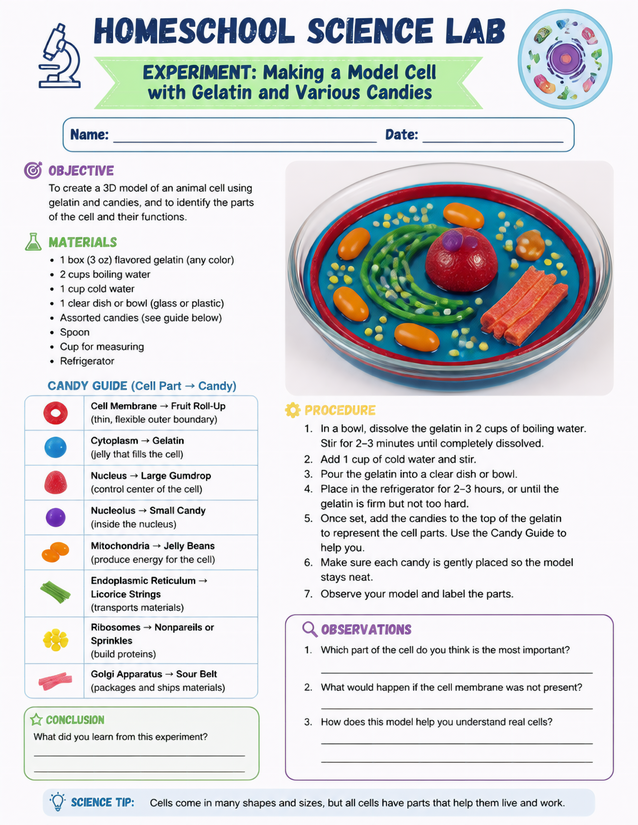
Grades 5-8 homeschool science: making a model cell with gelatin and candies teaches organelle identification through hands-on edible modeling.
Investigating Making a Model Cell with Gelatin and Candies

Usage Notes
Flavored gelatin, boiling water, a clear glass or plastic dish, and assorted candies cover the full materials list, and most of these are grocery store staples. The sheet specifies eight candy types by name in the guide, so a quick shopping list from the candy guide before lab day keeps things organized. Boiling water is the one safety note worth flagging with younger students.

Printing Tips
Card stock at 65 lb holds up better than copy paper when your student is handling a sticky, candy-covered model nearby. Slip the sheet into a page protector inside a lab notebook, or keep it loose on a clipboard so it stays flat and readable during the two-to-three hour refrigeration wait.